
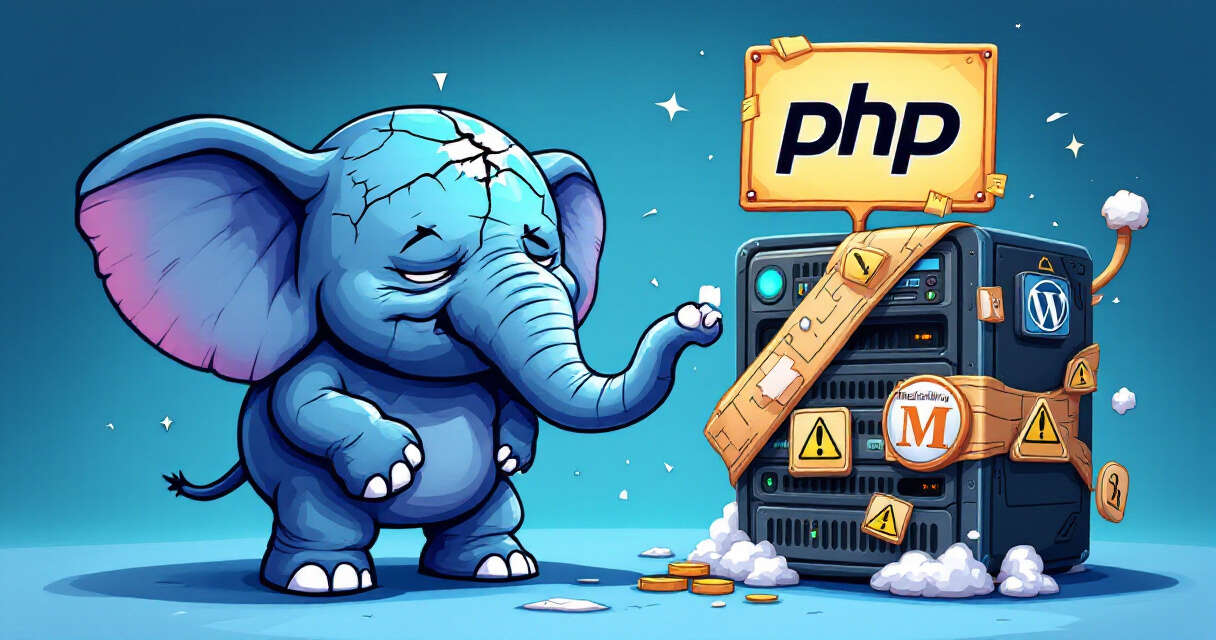
On Wednesday, a pair of long-dormant vulnerabilities in PHP sparked an emergency scramble across the internet. The bugs—dubbed PHP2Shell and assigned CVE‑2026‑109618 and CVE‑2026‑109619—allow unauthenticated remote code execution on affected systems. Once researchers demonstrated exploitability, vendors and web hosts rushed to apply patches released by the PHP Foundation, while companies and governments warned users and some organizations temporarily took services offline to protect themselves.
What happened
Security researchers at Calif discovered the two PHP flaws in 2024 but initially judged them non-exploitable and did not see an immediate need to patch. Recently, Calif and others found a way to weaponize those bugs and alerted the PHP Foundation. The Foundation coordinated a tightly controlled disclosure and released patches on Wednesday. Because the vulnerabilities allow attackers to run code remotely without credentials, they present a particularly dangerous class of flaw: unauthenticated remote code execution.
Why the bugs are so serious
Remote code execution lets an attacker gain substantial control over a system—installing malware, stealing data, or establishing persistent access. PHP2Shell’s ability to achieve this without any password made it especially alarming. Security firms warned that unpatched servers could be fully compromised if an exploit were deployed at scale. Palo Alto Networks and Trail of Bits later reported confirmed compromises and post‑exploit activity tied to the bugs, underlining that the risk had moved beyond theoretical to real.
How widespread the risk was
PHP has been a bedrock of the web for decades. Roughly 70% of web-facing sites rely on PHP, including many popular content management systems and platforms such as WordPress, Drupal, Joomla, and MediaWiki (which powers Wikipedia). That ubiquity meant that the potential attack surface was enormous. In response, banks, online retailers, gaming sites, hospitals, and some government agencies temporarily took servers offline or pulled services to install patches and reduce exposure.
Coordination, leaks, and early exploitation
To give large providers time to patch, the PHP Foundation shared the fixes under embargo with key companies. Despite those precautions, Amazon reported detecting exploitation attempts about a week before the public patches were available, suggesting someone had operational knowledge of the bugs prior to disclosure. The Foundation also blamed one company for prematurely publishing a patch that may have leaked exploit details. Researchers note that once patches are public—particularly for open‑source code—the location and nature of a fix can help attackers reverse‑engineer exploits, accelerating weaponization.
AI’s role in discovery (and limits)
Calif’s write‑up credits AI with assistance during exploitation development, but the team was clear that the heavy lifting relied on existing domain knowledge of PHP and its exploitation history. Their point: models can be useful tools, but they are not magic bug‑finding machines that replace expertise. The incident illustrates a real and growing dynamic—AI can accelerate certain research workflows, but it doesn’t eliminate the need for experienced researchers or careful disclosure practices.
Broader implications and the legacy-software problem
This episode highlights the fragility that comes with decades‑old, widely deployed software. Many core components of the internet are not memory‑safe and remain vulnerable to entire classes of memory-related flaws. The U.S. National Security Agency has noted that roughly 75% of actively exploited vulnerabilities are memory‑related—an observation that helps explain why attackers focus on older languages and libraries still in widespread use. The industry has been moving toward memory‑safe languages—Python, Rust, Swift, and others—but legacy systems, embedded devices, and third‑party products that incorporate PHP and similar components will take time (and money) to replace or secure. As a result, ripple effects from vulnerabilities like PHP2Shell may be felt for years, especially in environments that cannot be readily updated.
What organizations should take away
The immediate lesson is operational: apply the official PHP patches from the Foundation, scan server fleets for signs of exploitation (with dates to look back to as early as October 17, per Amazon’s telemetry), and prioritize updates for internet‑facing systems and embedded devices that bundle PHP. More broadly, the incident is a reminder that open‑source ecosystems depend on well‑coordinated disclosure processes and sustained investment in maintenance and security reviews. Until the internet’s foundational components are modernized or better supported, similar scares—exacerbated by faster research tooling—are likely to recur.
 Licensed under CC BY-ND 4.0 International