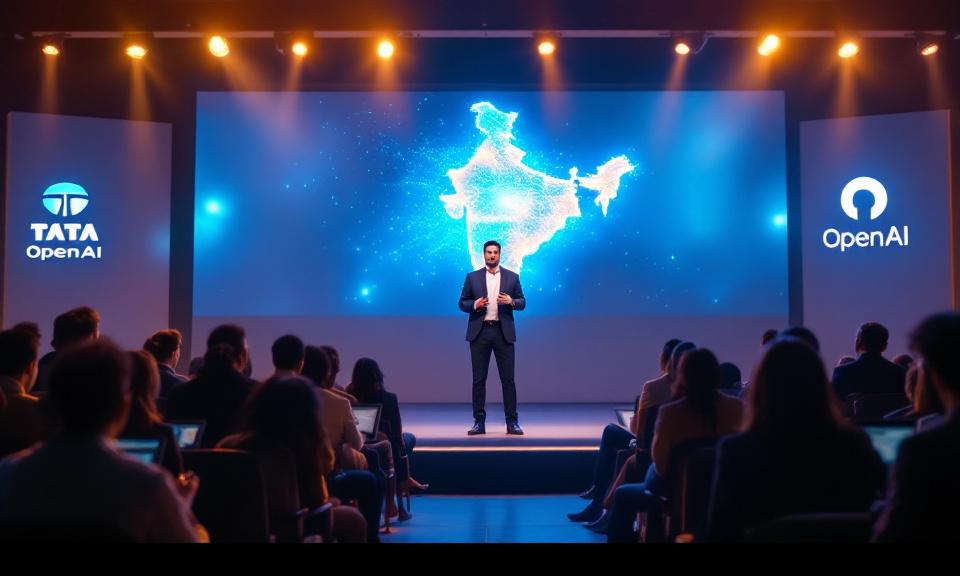
At the India AI Impact Summit, a clear narrative emerged: India is no longer a passive adopter of artificial intelligence but a fast-moving force shaping how the technology will be used and governed. OpenAI’s CEO, speaking to the momentum he observed on the ground, positioned India as a major market and a hub of adoption that could exert outsized influence on global AI trajectories. This is driven by a unique convergence of scale, digital infrastructure, developer talent, and entrepreneurial energy. Simultaneously, strategic alliances announced at the summit — most notably between OpenAI and major Tata Group entities — signal a shift from experimental pilots to industrialized, production-ready deployments tailored to local industries. Yet the promise carries responsibilities: preparing the workforce for new roles, building robust data and governance frameworks, and ensuring benefits reach beyond metropolitan centers. This blog unpacks the forces that position India to lead, explores what the Tata-OpenAI collaboration could deliver, examines implications for jobs and skills, and outlines the policy and inclusion measures necessary to turn promise into equitable progress.
Why India Is Adopting AI at Scale
India’s rapid AI adoption is not accidental; it is the product of long-term investments in digital infrastructure, an enormous base of digitally engaged users, and a deep reserve of engineering talent. The country’s telecom expansion, growing cloud availability, and ambitious national digital initiatives have created a large market that can both consume and co-create AI applications. Startups, mid-sized companies, and global tech firms all see India as a laboratory where scale experiments can be run affordably and iterated quickly. This environment encourages practical, outcome-driven applications — from automating customer service workflows to improving supply chain visibility and augmenting diagnostics in healthcare. Indian developers and data scientists are skilled at rapid prototyping and integration; combined with cost efficiencies, this lowers the barriers to taking AI projects from proof-of-concept to operational production.
Another accelerant is the diversity of use cases that emerge from India’s socio-economic complexity. Solutions that must work in a multilingual nation with varied infrastructure needs tend to be robust and adaptable, traits that increase their export potential. Enterprises that develop AI to handle local challenges — low-bandwidth conditions, heterogeneous datasets, and vernacular interfaces — create technology that can often be generalized for other emerging markets. Moreover, the sheer size of India’s user base provides valuable feedback loops that improve model performance and utility. That commercial feedback is attractive to global AI providers seeking scale and real-world validation.
Finally, the presence and active engagement of major platforms and research organizations amplify the effect. When leading AI companies open offices, partner with local integrators, or announce targeted investments, it signals commitment and reduces friction for domestic organizations keen to adopt advanced capabilities. The result is a virtuous cycle: adoption attracts investment, investment builds capability, and capability enables broader, more ambitious deployments.
What the Tata-OpenAI Partnership Could Deliver
The strategic collaboration announced between Tata Group affiliates and a major global AI provider marks an important inflection point. Tata’s deep domain expertise across finance, manufacturing, healthcare, energy, and consumer services combined with a global AI platform’s foundational models and tooling creates a bridge between abstract capabilities and concrete industry needs. Industry-specific “agentic” solutions — systems that can autonomously perform contextual tasks within domain constraints — are particularly compelling for sectors that require high reliability and compliance. Imagine an AI agent that autonomously triages vendor invoices, flags anomalies, initiates reconciliations, and communicates with stakeholders — or a healthcare assistant that pre-screens symptoms, prioritizes cases, and ensures clinicians have concise, relevant summaries.
Partnerships like this shorten the path from experimentation to scale. Tata’s systems integration skills and existing enterprise relationships can accelerate deployment pipelines and provide governance scaffolding, while the AI provider supplies the models, compute access, and ongoing innovation. This pairing can also lower compliance and risk management friction: enterprises get tailored integrations with better controls, while platform providers gain in-context feedback to refine models for industry constraints.
Infrastructure is another dimension. Localized compute and data infrastructure, possibly enabled through joint investments, can address latency, sovereignty, and cost concerns. For large enterprises and regulated sectors, keeping models and datasets within defined jurisdictions while maintaining access to advanced capabilities is often a prerequisite. Additionally, collaborative efforts can create training and certification pathways, ensuring that implementation teams have the necessary skills to manage, tune, and audit production systems. Ultimately, if executed responsibly, such alliances can be a catalyst for making AI both effective and widely accessible across Indian industries.
Jobs, Reskilling, and the Nature of New Work
One of the most consequential debates around AI is its impact on employment. The dominant narrative has shifted from fear of wholesale job loss to a more nuanced understanding: tasks, rather than whole occupations, will be transformed. Many routine, repetitive activities are likely to be automated, but new roles will emerge that require judgment, complex problem-solving, creativity, and oversight of AI systems. For India, which has a large workforce in services and manufacturing, this transition presents both a challenge and an opportunity.
Proactive reskilling programs are essential. Governments, educational institutions, and corporations must collaborate to build modular learning pathways that are affordable, accessible, and tightly aligned with employer needs. Micro-credentials, apprenticeships, and bootcamps targeting data literacy, AI tooling, system integration, and domain-specific AI application design can help workers pivot into roles that complement AI. Importantly, reskilling efforts must prioritize inclusivity: reaching workers in smaller towns and non-digital industries, subsidizing training where necessary, and recognizing prior experience so transitions are not prohibitively costly.
Another aspect is job redesign. Organizations can redesign roles to mix human strengths — empathy, ethical judgment, and contextual understanding — with AI’s speed and pattern recognition. New supervisory roles for AI systems, data curators, model auditors, and AI ethicists will be in demand. Moreover, entrepreneurship could flourish as accessible AI platforms lower the barrier to launching new services tailored to local needs. With the right public policies and corporate investments, India could leapfrog into a jobs landscape where human work is augmented, higher in skill content, and aligned with global digital opportunities.
Challenges Around Data, Governance, and Inclusion
Rapid AI adoption raises immediate questions about data governance, privacy, and equitable access. Models thrive on data, and ensuring that data collection, storage, and usage respect individual rights and national regulations is paramount. India will need robust frameworks that protect citizens while enabling responsible innovation. This involves clarifying consent standards, data portability rules, and guidelines for anonymization and de-identification. For sectors like healthcare and finance, stronger guardrails around data access and auditability will be necessary.
Governance also extends to model transparency and accountability. Enterprises deploying agentic systems must implement logging, monitoring, and human-in-the-loop controls to detect drift, bias, and misuse. Regulatory bodies should collaborate with industry to define standards for audits, incident reporting, and redress mechanisms. Building local capacity for independent model evaluation — whether through academic institutions, public labs, or accredited third parties — will help maintain trust.
Inclusion is another critical frontier. Urban tech hubs will naturally capture much of the early value, but equitable growth requires extending AI benefits to rural economies and small businesses. This could mean localized language models, low-bandwidth interfaces, and targeted support for micro, small, and medium enterprises to adopt productivity-enhancing tools. Public sector deployments — for agriculture advisories, public health outreach, and education — can be high-impact avenues to diffuse benefits more broadly.
How India Can Shape Global AI Norms
India’s emerging leadership position is not only about markets and deployments; it’s also an opportunity to influence how AI is governed globally. As Indian companies build systems that must operate across diverse linguistic, regulatory, and infrastructural contexts, they will develop practical insights into building resilient, adaptable models. These insights can contribute to global standards on durability, fairness, and contextual sensitivity.
Participation in international norm-setting forums, active contributions to open-source communities, and bilateral partnerships can amplify India’s voice. Moreover, India can champion approaches that prioritize human-centered AI: systems designed to complement livelihoods, respect privacy, and enhance democratic processes. By demonstrating scalable, responsible implementations at home — in areas like healthcare, agriculture, and governance — India can offer models for other nations balancing innovation with social priorities.
Ultimately, leadership will require a blend of private initiative, public policy, and civil society engagement. If India invests in infrastructure, skill-building, and governance while fostering collaborations between global platforms and domestic institutions, it can not only lead in adoption but also help define the values and operational norms that guide AI’s global future.
 Licensed under CC BY-ND 4.0 International

When a Jailbreak Became a Campaign: How Claude AI Was Abused to Build Exploits and Steal Data
In late 2025 a persistent attacker turned a conversational AI into a…

Anthropic’s Claude Mythos Leak: When Pre-Release Secrets Meet Cybersecurity Risk
Anthropic recently found itself at the center of an avoidable but consequential…

Introducing the Azure Skills Plugin: Practical Azure Workflows for Coding Agents
The Azure Skills Plugin brings curated Azure expertise and an execution layer…

When Local Trust Breaks: The OpenClaw 0-Click Vulnerability and What Developers Must Do Now
The speed at which developer-facing AI agents have been adopted is staggering…