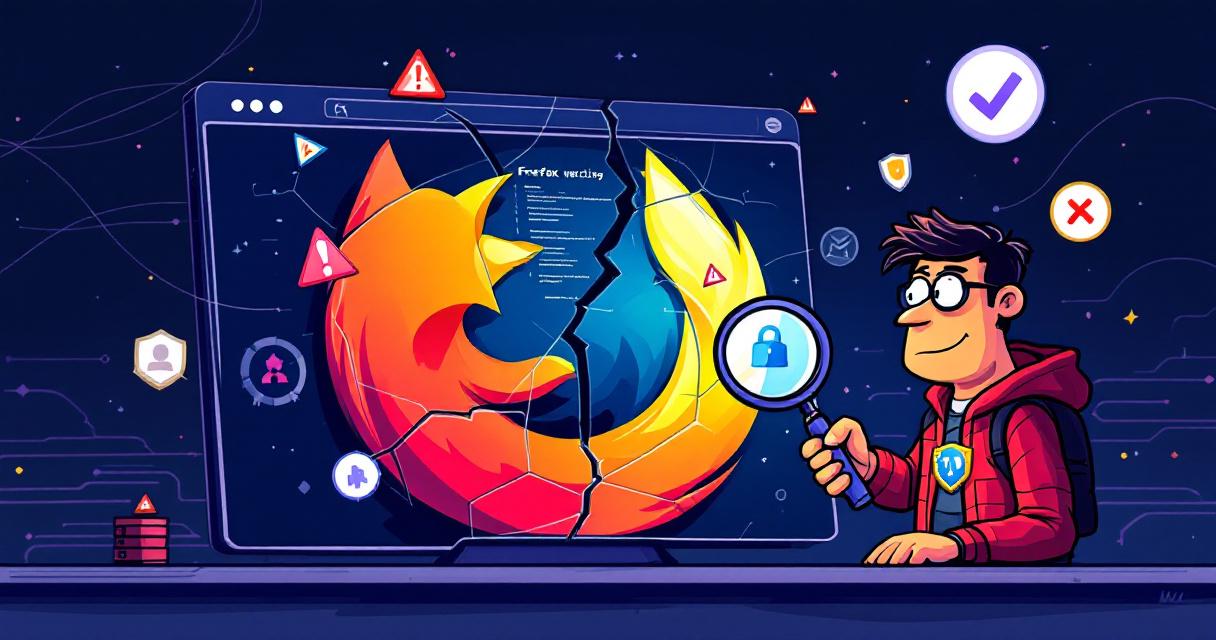
Mozilla released Firefox 149 on March 24, 2026, in one of the browser’s largest security updates in recent memory. The release fixes 37 vulnerabilities across memory corruption, sandbox escapes, use‑after‑free bugs, JIT miscompilation, and other issues that could enable remote code execution or privilege escalation. Given the number and seriousness of these fixes — 16 high‑severity issues among them — users and organizations should prioritize updating without delay.
A clear wake‑up call for browser security
Browsers are the primary battleground for web‑facing attacks, and Firefox 149 underscores how complex and interconnected modern browser components have become. Several of the patched flaws could allow attackers to break out of Firefox’s sandbox — the separation designed to limit what malicious web content can do. When sandbox escapes are possible, arbitrary code execution on the host becomes a realistic risk, which is why this update carries a widespread “high” impact rating from Mozilla.
What’s notable in Firefox 149
- Scope and scale: MFSA 2026‑20 bundles 37 CVEs: 16 high, 17 moderate, and 4 low. That breadth touches Graphics (WebRender), Canvas2D, WebRTC signaling, Telemetry, accessibility APIs, XPCOM, the JavaScript engine, and more.
- Sandbox escapes: Six confirmed sandbox escape vulnerabilities were patched — a particularly dangerous class of flaws because they can allow web content to escape isolation and run code on the underlying system.
- AI‑assisted discovery: For the first time at scale in a major browser advisory, a team of researchers used Claude (Anthropic) to surface multiple vulnerabilities. That AI‑assisted research contributed to several CVEs, including JIT and JavaScript engine issues, highlighting how increasingly capable tooling is reshaping vulnerability discovery workflows.
- Diverse reporters: The fixes reflect contributions from many independent researchers and teams, plus fuzzing efforts from Mozilla’s own teams.
High‑severity highlights
Among the most concerning patches are:
- CVE‑2026‑4684: Race condition and use‑after‑free in Graphics: WebRender (high).
- CVE‑2026‑4687 through CVE‑2026‑4690: Multiple sandbox escape issues across Telemetry, Disability Access APIs, and XPCOM (high).
- CVE‑2026‑4698: JIT miscompilation in the JavaScript Engine (high), which could enable arbitrary code execution.
- CVE‑2026‑4720, CVE‑2026‑4721, CVE‑2026‑4729: Memory safety rollup items with evidence of memory corruption (high).
Vulnerability table (as published)
| CVE ID | Vulnerability Description | Severity | Reporter |
|---|---|---|---|
| CVE-2026-4684 | Race condition, use-after-free | High | Oskar L |
| CVE-2026-4685 | Incorrect boundary conditions | High | Sajeeb Lohani |
| CVE-2026-4686 | Incorrect boundary conditions | High | Sajeeb Lohani |
| CVE-2026-4687 | Sandbox escape via incorrect boundary conditions | High | Sajeeb Lohani |
| CVE-2026-4688 | Sandbox escape via use-after-free | High | Sajeeb Lohani |
| CVE-2026-4689 | Sandbox escape via incorrect boundary conditions, integer overflow | High | Sajeeb Lohani |
| CVE-2026-4690 | Sandbox escape via incorrect boundary conditions, integer overflow | High | Sajeeb Lohani |
| CVE-2026-4691 | Use-after-free | High | Fabius Artrel |
| CVE-2026-4692 | Sandbox escape | High | Tom Ritter |
| CVE-2026-4693 | Incorrect boundary conditions | High | Sajeeb Lohani |
| CVE-2026-4694 | Incorrect boundary conditions, integer overflow | High | Sajeeb Lohani |
| CVE-2026-4695 | Incorrect boundary conditions | High | Atte Kettunen |
| CVE-2026-4696 | Use-after-free | High | Sota Wada |
| CVE-2026-4697 | Incorrect boundary conditions | High | Lorenzo |
| CVE-2026-4698 | JIT miscompilation | High | maxpl0it (Trend Micro ZDI) |
| CVE-2026-4699 | Incorrect boundary conditions | High | Matej Smycka |
| CVE-2026-4720 | Memory safety bugs (memory corruption / arbitrary code execution) | High | Christian Holler, Gabriele Svelto, Tom Schuster & Mozilla Fuzzing Team |
| CVE-2026-4729 | Memory safety bugs (memory corruption / arbitrary code execution) | High | Christian Holler, Fatih Kilic, Tom Schuster & Mozilla Fuzzing Team |
| CVE-2026-4721 | Memory safety bugs (memory corruption / arbitrary code execution) | High | Christian Holler, Timothy Nikkel, Tom Schuster & Mozilla Fuzzing Team |
| CVE-2026-4700 | Mitigation bypass | Moderate | pizzahunthack1 |
| CVE-2026-4701 | Use-after-free | Moderate | Gary Kwong |
| CVE-2026-4722 | Privilege escalation | Moderate | Nika Layzell |
| CVE-2026-4702 | JIT miscompilation | Moderate | Ben Asher et al. (via Claude/Anthropic) |
| CVE-2026-4723 | Use-after-free | Moderate | Ben Asher et al. (via Claude/Anthropic) |
| CVE-2026-4724 | Undefined behavior | Moderate | Ben Asher et al. (via Claude/Anthropic) |
| CVE-2026-4704 | Denial of service | Moderate | Ben Asher et al. (via Claude/Anthropic) |
| CVE-2026-4705 | Undefined behavior | Moderate | Ben Asher et al. (via Claude/Anthropic) |
| CVE-2026-4706 | Incorrect boundary conditions | Moderate | Jun Yang |
| CVE-2026-4707 | Incorrect boundary conditions | Moderate | Sajeeb Lohani |
| CVE-2026-4708 | Incorrect boundary conditions | Moderate | Sajeeb Lohani |
| CVE-2026-4709 | Incorrect boundary conditions | Moderate | Sajeeb Lohani |
| CVE-2026-4710 | Incorrect boundary conditions | Moderate | Sajeeb Lohani |
| CVE-2026-4711 | Use-after-free | Moderate | Josh Aas |
| CVE-2026-4725 | Sandbox escape via use-after-free | Moderate | Jun Yang |
| CVE-2026-4712 | Information disclosure | Moderate | Josh Aas |
| CVE-2026-4713 | Incorrect boundary conditions | Moderate | Sajeeb Lohani |
| CVE-2026-4714 | Incorrect boundary conditions | Moderate | Sajeeb Lohani |
| CVE-2026-4715 | Uninitialized memory | Moderate | Jun Yang |
| CVE-2026-4716 | Incorrect boundary conditions, uninitialized memory | Moderate | Pwn2addr |
| CVE-2026-4717 | Privilege escalation | Moderate | Satoki Tsuji |
| CVE-2026-4726 | Denial of service | Low | Hanno Boeck |
| CVE-2025-59375 | Denial of service | Low | Jan Horak |
| CVE-2026-4727 | Denial of service | Low | Cody |
| CVE-2026-4728 | Spoofing | Low | Aswinkumar Gokulakannan |
| CVE-2026-4718 | Undefined behavior | Low | Ben Asher et al. (via Claude/Anthropic) |
| CVE-2026-4719 | Incorrect boundary conditions | Low | Sajeeb Lohani |
Affected releases and mitigation
All vulnerabilities affect Firefox versions prior to 149. Firefox ESR channels (140.9 and 115.34) received corresponding patches for a subset of the issues. Mozilla’s guidance is straightforward: update to Firefox 149 using the built‑in updater or download directly from Mozilla. For organizations managing fleets, prioritize updates where sandbox escapes or remote code execution vectors are most relevant — for example, endpoints that handle untrusted web content or run web‑based productivity tools.
Practical advice for users and administrators
- Update now: For individual users, the simplest and most effective action is to update to Firefox 149 immediately.
- Enterprise patching: IT teams should schedule expedited testing and rollout, prioritizing high‑risk endpoints and any systems that process untrusted web content.
- Defense in depth: Complement browser updates with endpoint protections, application allowlists, and network controls that limit exposure to malicious web content.
- Monitoring: Watch for unusual process behavior or crashes that could indicate attempts to exploit browser vulnerabilities.
- Bug bounty and researcher engagement: Recognize that a large advisory like this reflects the collaborative work of external researchers, fuzzing teams, and sometimes new AI‑assisted methods. Maintain open lines with security researchers and consider proactive fuzzing or code review for critical in‑house extensions and integrations.
Why this matters beyond the immediate patch
This advisory also signals evolving dynamics in vulnerability discovery. AI tools are now part of the researcher toolkit, accelerating discovery but also raising questions about how quickly exploit techniques might be developed once issues are public. The presence of multiple sandbox escapes and memory corruption bugs in a single release is a reminder that browser complexity dramatically increases the attack surface — and that frequent, timely updates are an essential part of modern cyber hygiene.
Closing thoughts
Firefox 149 is a substantial update that addresses many serious risks. While patches for dozens of CVEs might feel overwhelming, the path forward is simple and direct: apply the update, prioritize endpoints at greatest risk, and keep defensive layers in place. The combination of human researchers, fuzzing programs, and new AI methods is improving our ability to find bugs — but it also shortens the window between disclosure and potential exploitation. Treat this release as a prompt to review browser patching practices and incident readiness one more time.
 Licensed under CC BY-ND 4.0 International

Citrix Warns: Patch NetScaler ADC and Gateway Flaws Immediately
Citrix has released urgent security updates for NetScaler ADC and NetScaler Gateway…

Chrome Security Update Fixes 26 Vulnerabilities That Could Allow Remote Code Execution
Google’s latest Chrome security update is a reminder that even the world’s…

Microsoft .NET Out-of-Bounds Read (CVE-2026-26127) Causes Remote Denial-of-Service Risk
Microsoft has issued an emergency security update to address a newly disclosed…
When Local Trust Breaks: The OpenClaw 0-Click Vulnerability and What Developers Must Do Now
The speed at which developer-facing AI agents have been adopted is staggering…