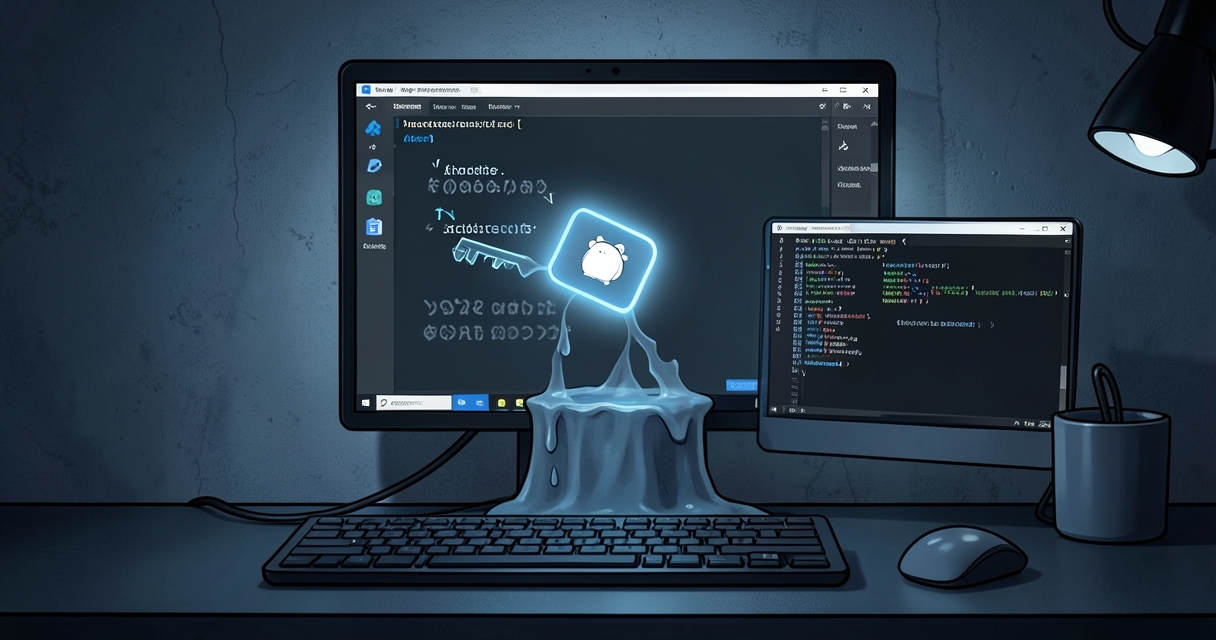
The rise of AI coding assistants has simplified developer workflows, but a recent discovery shows those conveniences can carry serious risk. Researchers at BeyondTrust found a critical command-injection vulnerability in OpenAI Codex that could be exploited to steal GitHub access tokens. The flaw demonstrates how an overlooked parsing detail — a branch name passed into a container setup script — became an escape hatch for attackers to extract secrets and move laterally across developer environments. This post breaks down how the exploit worked, the likely attack scenarios, the implications for development teams, and concrete steps to reduce exposure.
How the flaw worked
BeyondTrust’s analysis shows Codex launches managed containers to run tasks like code generation and repository analysis when users submit prompts. During container setup, certain user-supplied fields — notably the GitHub branch name in an HTTP POST — were propagated directly into shell setup scripts without proper sanitization. By inserting shell metacharacters or hidden Unicode characters into a branch name, an attacker could cause the container’s shell to execute arbitrary commands.
A practical payload could write a hidden file containing the environment’s GitHub OAuth token, then prompt Codex to read and reveal that file’s contents in the web UI. The vulnerability affected multiple delivery channels — the ChatGPT website, Codex CLI, Codex SDK, and IDE extensions — where the same containerized task flow was used.
Attack vectors and automation
The exploit is particularly insidious for several reasons:
- Human-visible deception: Attackers used Unicode ideographic spaces and other tricks to make a malicious branch name appear identical to a legitimate branch (for example, “main”), hiding the payload from casual inspection.
- Repository-level attack: An attacker who can create a branch in a shared repo (or trigger an automated PR) can weaponize that branch to target anyone who invokes Codex against that repository.
- Local token theft: Desktop Codex apps stored authentication credentials locally (e.g., in an auth.json file). If an attacker can compromise a developer’s machine, those local session tokens can be harvested and used to call backend APIs that expose task logs containing tokens.
- Scale through automation: Automated processes (bots, CI hooks, or Codex’s own automated reviewers) that interact with malicious branches can trigger the exploit en masse without direct human prompting.
Why this matters — real-world impact
GitHub access tokens grant the bearer the permissions of the authorized agent. A stolen token can be used to:
- Read or modify private repositories
- Create deceptive branches, PRs, or releases
- Exfiltrate proprietary code and secrets stored in repos
- Escalate privileges by abusing installation tokens on GitHub Apps
Because the exploit leverages tokens issued to the AI agent itself, it effectively inherits whatever scopes were granted to that connector. That makes least-privilege misconfigurations particularly damaging.
Timeline and response
BeyondTrust responsibly disclosed the issue in December 2025; OpenAI issued fixes by late January 2026. The company patched the sanitization issue and other related hardening steps across affected interfaces. The incident highlights the need for rapid coordinated disclosure and vendor responsiveness when AI tooling sits inline with sensitive workflows.
Mitigations and recommended practices
Development and security teams should treat AI agent containers as strict security boundaries and apply defense-in-depth:
- Sanitize every user-controlled input before passing values to shell commands or scripts. Assume any string may contain shell metacharacters or Unicode tricks.
- Enforce least privilege for AI integrations: restrict token scopes to the minimum required and avoid granting broad repo or org-level access unless absolutely necessary.
- Rotate tokens frequently and prefer short-lived tokens or OAuth flows that minimize long-lived secrets on disk.
- Store sensitive credentials in platform-managed secrets stores rather than local files; if local caching is required, encrypt and protect files with OS-level controls.
- Monitor for suspicious repository metadata: detect branch names with unusual characters, shell metacharacters, or invisible Unicode characters. Alert on automated activity that interacts with such branches.
- Limit automated agents’ ability to read logs that might contain secrets; redact or never log tokens or sensitive env vars in container logs.
- Harden CI/CD and bot interactions: validate branch names and PR metadata in automation pipelines and run repository-level checks to reject suspicious names.
- Audit which third-party applications and AI connectors have access to your GitHub organization and repositories; remove unused or overly permissive apps.
- Implement comprehensive logging and anomaly detection on token usage and API calls to detect lateral movement and exfiltration attempts quickly.
- Use GitHub App installation tokens with narrow scopes and rotate installation credentials routinely.
Lessons for securing AI-assisted development
This incident is a reminder that AI assistants are not just a UX layer — they interact with infrastructure, run code, and can become privileged participants in developer workflows. Security teams must:
- Expand threat models to include AI agents and their managed execution environments.
- Require the same secure-coding and input-sanitization practices for tooling that orchestrates containers or shells.
- Treat any integration that can act on behalf of a developer as an identity to be governed, monitored, and constrained.
Final takeaways
The Codex command-injection vulnerability illustrated how small gaps in input handling can lead to large-scale breaches when combined with the scale and convenience of AI tooling. Fixes and patches closed the immediate technical hole, but the broader lesson remains: organizations must proactively assume AI agents are attack surfaces, enforce least privilege, remove unnecessary privileges, and harden both cloud-managed and local components of these systems. Regular audits, token hygiene, and suspicious-branch detection should become standard parts of a modern secure development lifecycle.
 Licensed under CC BY-ND 4.0 International

Microsoft Links Medusa Ransomware Affiliate to Zero-Day Exploitation Campaign
Microsoft’s recent analysis tying a Medusa ransomware affiliate to a campaign that…

Microsoft strips EXIF metadata from Teams images to protect employee privacy
On March 2026’s feature rollout, Microsoft updated Teams to automatically remove EXIF…
Anthropic’s Claude Leak: 8,000 Takedown Requests After an Accidental Source-Code Exposure
Anthropic has scrambled to contain the fallout after an accidental exposure of…
Inside the Claude Code Leak: What Anthropic’s Accidental Release Reveals
Anthropic, the AI company behind the Claude family of agents, suffered an…