Security teams are drowning in scanner output: thousands of findings a day, many irrelevant or impossible to exploit. AWS Continuum for code vulnerabilities aims to change that dynamic by validating which findings are actually exploitable in your environment, ranking issues by business impact, and proposing concrete remediations that integrate directly into developer workflows. It combines code analysis, environment context, and sandboxed reproduction to move teams from manual triage to prioritized, reviewable fixes.
Why generic severity isn’t enough
Scanner severity alone often misleads. A “critical” finding in a development-only utility can look identical to a “medium” issue on a service that sits next to production databases. Determining true risk requires knowing network reachability, ownership, service dependencies, and which data flows through each system. Continuum addresses this gap by building a context graph that represents both your code and your AWS environment, enabling it to assess whether a vulnerability is reachable and what an attacker could actually access from it.
How Continuum analyzes and validates findings
Continuum ingests code sources (GitHub integrations or Amazon S3 buckets) and—optionally—AWS environment data via a collector deployed in the account and Region where the code runs. From these inputs it constructs a context graph that identifies business-critical systems, ownership, and service dependencies. Findings are then evaluated against that context and assigned an evidence level (for example, “Static proven”). When possible, Continuum reproduces an exploit in an isolated sandbox and attaches proof-of-concept code and reproduction steps. Rather than a lone risk score, each validated issue includes an attack path, source analysis, and a blast radius assessment that shows potential downstream impact.
Remediations that fit developer workflows
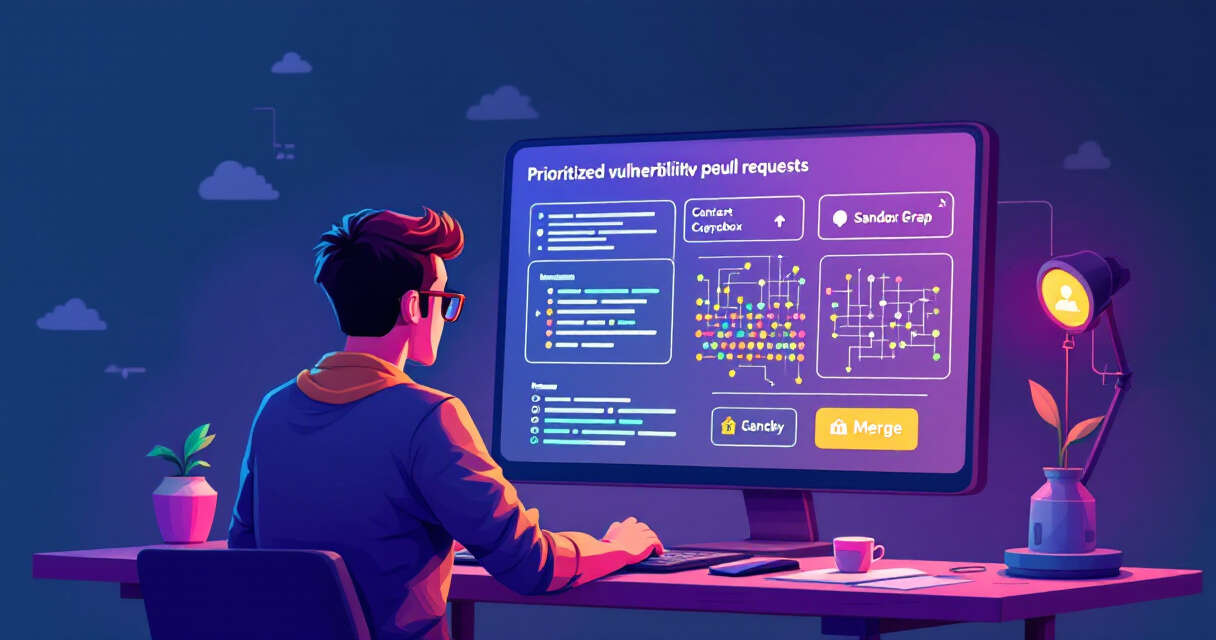
For confirmed issues, Continuum generates fixes—patches, dependency upgrades, or configuration changes—and opens them as pull requests in the connected repository. Pull requests include the same risk assessment, remediation summary, and proof, giving reviewers the full context without leaving their GitHub workflow. Every suggested fix starts in a human-approval mode: your team reviews and merges the PR, keeping the final decision internal. AWS plans to add confidence gates (test coverage, scope bounds, historical success rate) so teams can allow Continuum to apply certain remediation classes automatically under tightly defined guardrails.
Operational experience in the console
In the Continuum console you organize code integrations and environments, enable optional AWS collectors, and configure scan cadence. The Issues view shows validated, prioritized issues rather than raw scanner noise, with severity, status, evidence level, and risk assessment. Each issue explains exploitability and likelihood, and links to the generated pull request where you can review and merge the proposed change. Scans and findings are available in dedicated tabs so you can trace origin, timing, and the raw scanner input behind every validated issue.
Deployment and prerequisites
You can connect code sources through a GitHub integration or an Amazon S3 bucket (S3 buckets must be in the same account and Region as Continuum and require an IAM role for access). Adding an AWS Continuum collector requires deploying it in the account and Region where your code runs so Continuum can gather AWS Config and network configuration details. These environment signals are what allow Continuum to judge reachability and construct meaningful attack paths.
Practical considerations for teams
Start by connecting high-value codebases and enabling collectors for production-like environments so the context graph reflects code and infrastructure that matter most. Tune scan frequency to match release cadence and prioritize environments tied to customer data, payments, or authentication. Treat the first phase as a visibility and prioritization upgrade: use generated pull requests as a deliberate way to shrink backlog while preserving human review. Over time, measure Continuum’s remediation accuracy and, where appropriate, enable automated fixes within narrow, auditable boundaries.
Availability and next steps
AWS Continuum for code vulnerabilities is available in US East (N. Virginia) and US West (Oregon) Regions. For pricing, documentation, and detailed setup steps, consult the Continuum product page and the User Guide. If you manage a large application estate and want to reduce triage time while keeping control of fixes, try connecting a high-value repo and an AWS collector to see how validated, prioritized issues and generated pull requests change your remediation workflow.
 Licensed under CC BY-ND 4.0 International