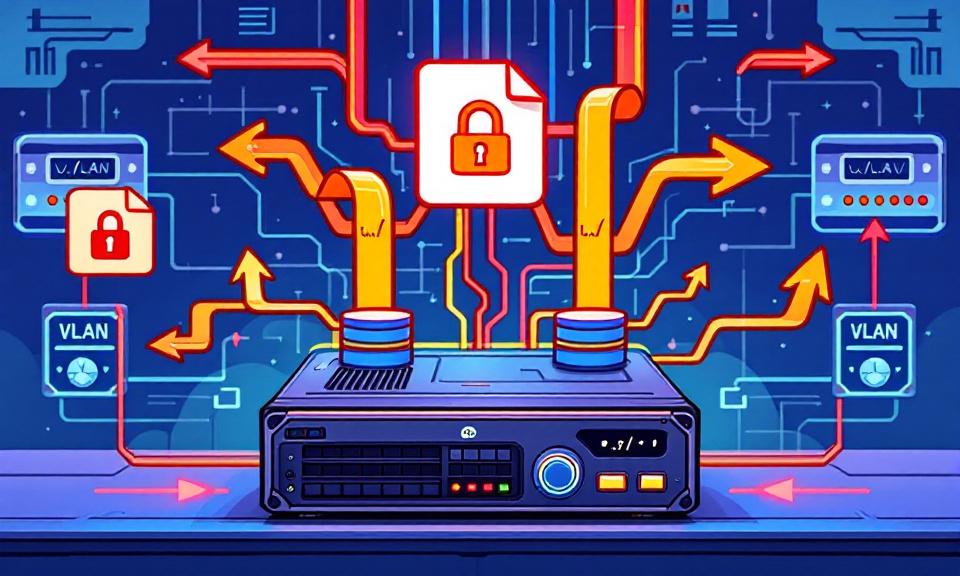
Ubiquiti has quietly become a household name for network hardware in small-to-midsize enterprises, campuses, and savvy home setups. That trust makes the recent disclosure of two serious flaws in the UniFi Network Application especially alarming: one is a maximum-severity path traversal that can enable a full system takeover, and the other is an authenticated NoSQL injection that can escalate privileges. Both merit immediate attention from operators, because the technical details translate directly into real operational risk.
Background: why this matters
Network controllers like the UniFi Network Application are central — they store configuration, host credentials, and can be a bridge into administrative systems. A vulnerable controller isn’t just a single point of failure; it’s a potential pivot into the rest of the environment. When a flaw allows unauthenticated remote access to filesystem contents, or lets an authenticated low-privilege user change database queries, the consequences can be catastrophic: credential theft, configuration tampering, and full host compromise.
The two flaws explained
CVE-2026-22557 — critical path traversal
- What it is: A path traversal vulnerability rated CVSS 10.0 — the maximum score. It permits an attacker with network access to traverse directory boundaries in the UniFi application and read or manipulate sensitive files on the host OS.
- Why it’s dangerous: The exploit requires no authentication and no user interaction. An attacker can potentially extract secrets, overwrite key files, or craft changes that let them take administrative control of the underlying system.
CVE-2026-22558 — authenticated NoSQL injection
- What it is: A NoSQL injection flaw that requires authentication but enables privilege escalation and data confidentiality impact (CVSS ~7.7).
- Why it’s dangerous: An attacker who already has low-level credentials — through phishing, credential reuse, or another foothold — could inject malicious queries to elevate privileges, access network configuration, or modify internal account structures.
Who and what is affected
- UniFi Network App (Official): versions 10.1.85 and earlier
- UniFi Network App (Release Candidate): versions 10.2.93 and earlier
- UniFi Express (UX): Network App 9.0.114 and earlier
Patched versions released by Ubiquiti
- Official Release: upgrade to UniFi Network Application 10.1.89 or later
- Release Candidate: upgrade to UniFi Network Application 10.2.97 or later
- UniFi Express (UX): update firmware to 4.0.13 or later (bundles Network App 9.0.118 or later)
Immediate steps for administrators (what to do now)
- Patch immediately: If you manage affected installations, prioritize upgrading to the patched versions listed above. Treat this as an emergency patch, especially for instances exposed to the internet.
- Isolate exposed management interfaces: If public access to the UniFi controller is necessary, restrict it with strict firewall rules or preferably VPN-only management. Limit sources that can reach the controller’s ports.
- Audit for indicators of compromise: Check logs, look for unexpected file reads/writes, new accounts, or changes to system binaries/configuration. Investigate anomalous authentications and administrative actions.
- Rotate credentials and keys: Replace any credentials, API keys, or certificates stored on affected controllers after you’ve confirmed a clean state—or better, after a rebuild if compromise is suspected.
- Backup before and after remediation: Ensure you have recent backups of configurations, but avoid restoring from potentially compromised snapshots without validation.
Longer-term hardening and operational lessons
- Minimize exposed management surfaces: Network controllers should not be internet-facing by default. Use bastion hosts, VPN gateways, or jump boxes for administrative access.
- Apply network segmentation: Keep controllers on dedicated management VLANs and restrict lateral movement through internal firewalls and strict access control lists.
- Enforce least privilege and MFA: Limit accounts to the minimal rights they need; protect admin access with multi-factor authentication where supported.
- Monitor and alert aggressively: Enable and centralize logs for controller activity, and create alerts for configuration changes, unexpected administrative logins, and file integrity anomalies.
- Practice incident response: Have a tested playbook for controller compromise that covers containment, eradication, credential rotation, and post-incident validation.
When to assume compromise and what that implies
Because the more severe vulnerability requires no authentication and can expose sensitive files, any controller that was internet-exposed prior to patching should be treated as potentially compromised. That may require rebuilding the host or reinstalling the controller on a clean system, followed by reconfiguring from validated sources and rotating all related credentials.
Final thoughts
The combination of an unauthenticated, critical path traversal and a high-impact authenticated injection is a stark reminder that infrastructure components we trust can become attack vectors overnight. Prompt patching, reducing exposure, and solid operational hygiene are the only practical defenses. If you run UniFi Network Application in production or on any device reachable from untrusted networks, prioritize this update and assume urgency — your network’s integrity may depend on it.
 Licensed under CC BY-ND 4.0 International
ActiveMQ broker RCE tied to CVE-2026-34197: what admins need to know
A long-standing flaw in Apache ActiveMQ has resurfaced as a serious concern…
Critical RCE in Ninja Forms File Upload Exposes ~50,000 WordPress Sites
A recently disclosed vulnerability in the popular Ninja Forms “File Upload” addon…
Researcher Publishes Windows Defender 0-Day ‘BlueHammer’ LPE Proof‑of‑Concept
A security researcher using the handle Chaotic Eclipse has publicly released a…

Microsoft Links Medusa Ransomware Affiliate to Zero-Day Exploitation Campaign
Microsoft’s recent analysis tying a Medusa ransomware affiliate to a campaign that…