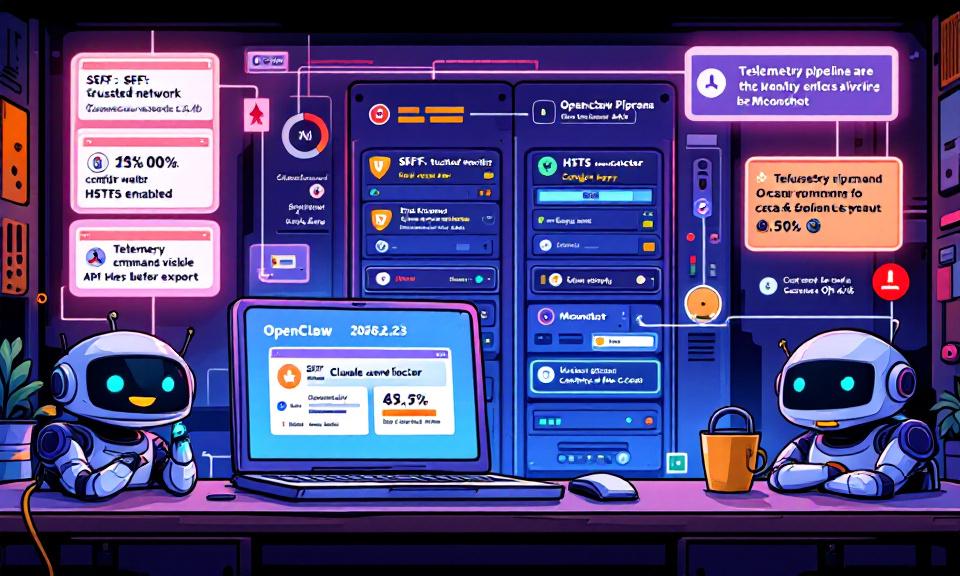
OpenClaw’s 2026.2.23 release is one of those updates that signals the project maturing from a fast-moving, feature-first AI assistant into a hardened platform ready for production gateways and privacy-conscious deployments. Tagged by steipete and contributed to by dozens of maintainers, this version balances pragmatic security hardening with meaningful AI improvements: support for Claude Opus 4.6 via the Kilo gateway, improved media and provider integrations, and a set of defensive changes that reduce attack surface across SSRF, stored XSS, telemetry leakage, and risky execution paths.
Introduction
OpenClaw’s position as a local, multi-model AI hub—often deployed on macOS, Windows, or Linux as a gateway for messaging apps and personal assistants—makes its security posture critical. Users increasingly run model access and tooling in environments with private networks, sensitive keys, and long-lived sessions. 2026.2.23 deliberately addresses those operational realities: it limits implicit trust in private networks, redacts sensitive data in config and diagnostics, enforces safer execution of dynamic commands, and tightens packaging rules for user‑supplied skills and assets. For teams converting hobby deployments into production-facing gateways, these changes materially reduce risk.
Why this release matters
OpenClaw’s position as a local, multi-model AI hub—often deployed on macOS, Windows, or Linux as a gateway for messaging apps and personal assistants—makes its security posture critical. Users increasingly run model access and tooling in environments with private networks, sensitive keys, and long-lived sessions. 2026.2.23 deliberately addresses those operational realities: it limits implicit trust in private networks, redacts sensitive data in config and diagnostics, enforces safer execution of dynamic commands, and tightens packaging rules for user‑supplied skills and assets. For teams converting hobby deployments into production-facing gateways, these changes materially reduce risk.
What’s new — security hardening (high level)
- SSRF policy hardened: The browser SSRF policy now defaults to trusted-network. That shifts from permissive behavior to a safer mode that blocks unsolicited access to internal resources unless explicitly permitted. This is a breaking/default-change for some legacy deployments and reduces opportunities for remote request-forging.
- Optional HTTP security headers: OpenClaw can now add standard headers such as Strict-Transport-Security (HSTS) for direct HTTPS deployments. These headers are shipped with validation, test coverage, and documentation to reduce man-in-the-middle and downgrade risks for direct-access gateways.
- Session maintenance and disk controls: “openclaw sessions cleanup” introduces disk-budget controls and safer handling of conversation transcripts to prevent unbounded storage growth and accidental exposure of conversation data.
- Config redaction: Snapshots and config exports redact sensitive dynamic keys (env.* and skills.env.*) while preserving restore semantics. This prevents accidental leakage of secrets during support or migration.
- Execution and command safety: Obfuscated or suspicious commands now trigger explicit approval, blocking silent execution of injected payloads.
- ACP client and file access restrictions: ACP client permissions now require trusted tool IDs and scoped read approvals to prevent unauthorized file access by third-party tools.
- Skills packaging safety: Packaging rejects symlink escapes and blocks XSS-vulnerable prompts in image gallery outputs, mitigating common ways attackers try to escape sandboxes or craft stored XSS payloads.
- OTEL diagnostics redaction: Observability exports scrub API keys and sensitive telemetry before export, closing a channel that could leak credentials to external collectors.
Breaking change and migration notes
- SSRF default mode change: The move to trusted-network by default is a deliberate security posture shift. Administrators with internal workflows that rely on the previous allowPrivateNetwork behavior must explicitly opt back in or migrate legacy settings. OpenClaw includes a migration helper: openclaw doctor –fix, which will surface issues and apply automated adjustments where safe. Still, operators should test the effect in staging before flipping production.
- Test and rollback plans: Because session handling, config snapshots, and redaction affect backup/restore and support workflows, implement a staged rollout: run 2026.2.23 in non-production, validate snapshot restores, and ensure automated monitoring behaves as expected before promoting.
AI and provider feature highlights
- Claude Opus 4.6 via Kilo Gateway: First-class Kilo Gateway integration, with kilocode/anthropic/claude-opus-4.6 configured as a default option, including authentication flows, onboarding helpers, and caching strategies. This simplifies adopting new Anthropic models.
- Provider normalization and Moonshot additions: Vercel AI Gateway now normalizes shorthand Claude references. The tools/web_search integration adds a Moonshot “kimi” provider to improve citation extraction in search results.
- Media and video: Native Moonshot video support and refactored execution paths improve media understanding and ensure better header/URL precedence when fetching resources.
- Agents and caching improvements: Agents can use per-agent parameter overrides for cacheRetention and bootstrap caching to limit prompt invalidation across models. Prompt caching docs were clarified to help deployments tune retention across Bedrock/OpenRouter and other backends.
- Resilience fixes: The release tightens context pruning for Moonshot/Kimi providers, resolves model resolution for default fallbacks, and improves overflow detection and failover behavior for provider 502/503 responses.
Operational guidance — what teams should do next
- Inventory and plan: Identify deployed OpenClaw instances and their exposure (public web, internal-only, local desktop). Note which ones rely on internal network requests or vendor integrations that might be impacted by the SSRF policy change.
- Staging first: Deploy 2026.2.23 in a staging environment. Run openclaw doctor to surface migration recommendations and test snapshot/restore flows to confirm config redaction and session cleanup won’t unexpectedly break operations.
- Review gateway TLS and headers: If you’re terminating TLS at the gateway or exposing a direct HTTPS endpoint, enable and validate the new HTTP security headers (HSTS) and test with your clients and reverse proxies.
- Validate telemetry and observability: Confirm OTEL exports are properly redacting keys and that your monitoring pipeline still receives the necessary diagnostics without sensitive data leakage.
- Reassess permissions for tools and skills: Audit ACP client permissions, trusted tool IDs, and any skill packaging you accept from third parties. Repackage or reject legacy skills that rely on symlink escapes or produce HTML prompts that could be XSS-vulnerable.
- Adjust caching and agent configs: Use per-agent overrides to tune caching retention so you get the benefits of prompt cache without undesirable prompt staleness in multi-provider setups.
- Update runbooks: Add rollback guidance to your release notes, and update incident response and compliance documentation to reflect redaction behavior and new session retention rules.
Developer and contributor implications
- Code hygiene and tests: The release places more emphasis on validation, tests, and documentation. Contributors should model similar rigor for future features—particularly around security-related changes that affect defaults.
- Packaging constraints: If you develop third-party skills or UI components, avoid relying on filesystem tricks like symlink escapes. Keep HTML outputs sanitized and consider explicit content-escaping libraries to avoid introducing XSS vectors.
- Observability hygiene: When adding diagnostic fields, treat any token-like or credential-shaped values as sensitive by default and add them to redaction policies.
Risks and trade-offs
- Usability vs. safety: Defaulting to trusted-network for SSRF and redacting keys from snapshots increase safety, but they introduce friction for deployments that relied on permissive defaults. The release favors a conservative security posture; operators should budget time for migration and testing.
- Breaking changes require coordination: Teams that expose OpenClaw to large user bases or integrate many third-party skills will need to coordinate rolling upgrades carefully to avoid unexpected interruptions.
Conclusion
OpenClaw 2026.2.23 is a significant step toward a production-grade, privacy-forward AI gateway. By coupling new model and provider support with careful security controls—SSRF hardening, config redaction, safer execution paths, OTEL scrubbing, and packaging safeguards—the project addresses the most common risks of operating multi-model assistants in real environments. The release nudges operators to adopt safer defaults, and while some changes require migration work (notably SSRF behavior), the overall effect is a more robust platform for anyone running local AI gateways at scale.
Credits and community
Tagged by steipete and built with contributions from dozens of developers. For operators and contributors, review the release notes and migration guidance in the OpenClaw repository and run the included doctor tooling to smooth the upgrade path.
 Licensed under CC BY-ND 4.0 International

OpenAI Agents on Wikimedia: What Happened, What It Means, and What Comes Next
Recently disclosed investigations show clusters of autonomous AI agents — many traced…

Let’s Encrypt Temporarily Halts Certificate Issuance Following Root Incident
On May 8, 2026, Let’s Encrypt, the widely used non-profit certificate authority,…

Mass Exposure: What the CPR Breach Means for 8.8 Million People in Denmark
Denmark's central population register (CPR) was the target of a large-scale data…

When a Private Diary Becomes Evidence: How a Claude Entry Led to Real-World Charges
A single chat entry that a user treated like a private diary…
Atlassian Urges Immediate Patching After Critical Arbitrary File-Access Flaw
Atlassian has released emergency fixes for a critical arbitrary file access vulnerability…

Android 17 Brings Six Targeted Protections — What High-Risk Users Need to Know
Google’s latest security push for Android 17 stitches together a set of…

When Speed Breaks Safety: OpenAI Safety Lead Says Company Culture Is ‘Broken’
David Robinson’s resignation has sent another shock through the AI community: a…

Vercel Confirms KVM Zero-Day VM Escape, Awards Researcher $50,000
Vercel has publicly acknowledged a reported KVM zero-day that a security researcher…