
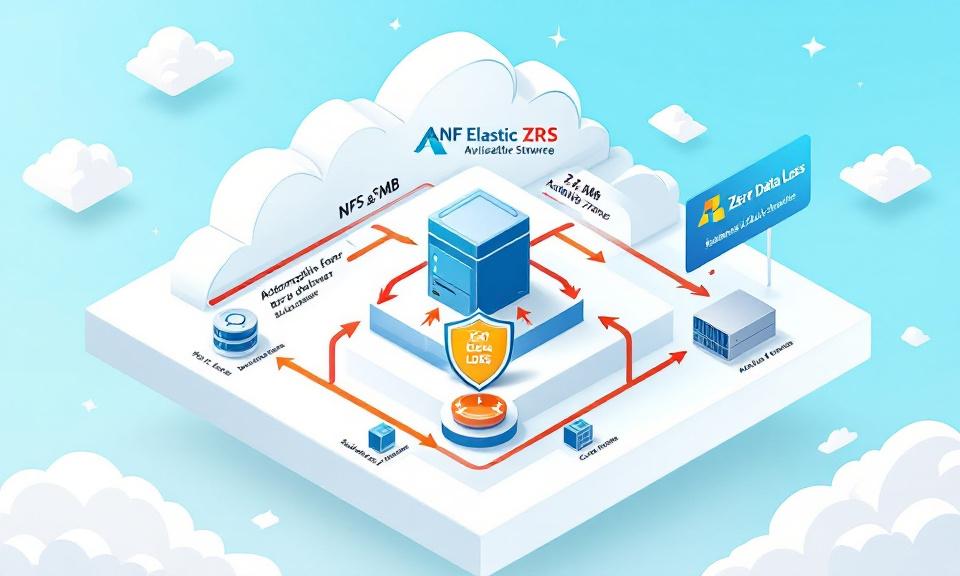
Data resiliency is a baseline requirement for modern enterprise applications. Short interruptions or data loss can cascade into regulatory, financial, and reputational consequences. Azure NetApp Files (ANF) Elastic zone‑redundant storage (ANF Elastic ZRS) is a managed, multi‑AZ file storage option built on Azure’s ZRS architecture that aims to deliver synchronous multi‑zone replication, automatic failover, and enterprise ONTAP data management features in a single volume. This post summarizes the service’s capabilities, operational model, supported workloads, and planned enhancements—sticking to the facts and source material.
What ANF Elastic ZRS is and why it matters
ANF Elastic ZRS provides a zone‑redundant ANF volume that synchronously replicates data across three or more availability zones (AZs) within a single Azure region. The service is designed to deliver zero data loss and continuous availability for mission‑critical file workloads by combining synchronous replication with service‑managed failover. Because the mount target and service endpoint remain consistent during failover, applications experience minimal disruption.
Key operational behaviors
- Synchronous replication: Data written to an ANF Elastic ZRS volume is replicated synchronously across multiple AZs within the chosen primary region, ensuring that committed writes are durably stored in at least three zones.
- Service‑managed failover: If an AZ becomes unavailable (for example, due to a datacenter outage), ANF Elastic ZRS automatically routes traffic to the preconfigured failover zone without customer intervention. The network endpoint and mount target remain the same.
- Zero data loss guarantee: The combination of synchronous replication and managed failover is intended to provide uninterrupted operations for regulated and mission‑critical applications, meeting enterprise resiliency expectations.
Core capabilities
Protocol support and multi‑AZ file service: ANF Elastic ZRS supports NFS and SMB protocols with zone redundancy, enabling both Linux and Windows workloads to use the same resilient file service model (note: simultaneous multi‑protocol access is listed as a planned future capability).
Enterprise ONTAP data management: The service includes ONTAP features such as instant writable space‑efficient snapshots, clones, tiering, and integration with backups.
Metadata performance and QoS: ANF Elastic ZRS emphasizes metadata operation performance (rapid file creation, fast enumeration of many small files) and uses a shared QoS architecture that dynamically allocates IOPS across volumes to keep latency low for metadata‑heavy workloads.
Cost efficiency and granularity: A single ANF Elastic ZRS volume delivers multi‑AZ high availability more cost‑efficiently than replicating three separate ANF volumes across zones. Volumes can be as small as 1 GiB, giving flexibility for different workload sizes.
Planned or coming capabilities
- Simultaneous multi‑protocol, multi‑AZ file service: Planned support for using NFS, SMB, and Object REST API access concurrently to the same dataset—important where Windows and Linux workloads share data.
- Custom region pairing for cross‑region replication: Planned capability to choose custom region pairs for cross‑region replication to meet compliance and disaster recovery requirements.
- Migration Assistant: A forthcoming tool to simplify data movement from on‑premises or other ONTAP systems into the Elastic ZRS service level.
Targeted use cases (preserved table)
| Use case | How ANF Elastic ZRS helps |
|---|---|
| General file shares | Corporate user data—including home directories and departmental shares—remain accessible during zone outages, preserving employee productivity and business continuity. |
| Financial services and trading platforms | Zero data loss and continuous operation during a zone outage help maintain compliance and uninterrupted trading activity. |
| Kubernetes/containerized applications | Keeps stateful container workloads online during zone outages by synchronously synchronizing data across zones and enabling fast, automated failover; stateful apps remain available with minimal downtime. |
| Applications | Ensures nonstop access to in‑house or line‑of‑business apps during an AZ failure, keeping transactions online with zero data loss. |
Real‑world scenario: healthcare migration example
A global healthcare organization with mission‑critical, on‑premises applications adopted ANF Elastic ZRS to modernize into the cloud while preserving high availability. By using ANF Elastic ZRS, the organization gained synchronous replication across three AZs, automated failover, and the ONTAP feature set without managing HA clusters or custom VM failover logic. The result described in the source is higher SLA compliance, lower operational overhead, and a resilient storage foundation for regulated, mission‑critical applications.
How ANF Elastic ZRS compares operationally to other approaches
Versus three separate ANF volumes with cross‑zone replication: ANF Elastic ZRS provides a single, zone‑resilient volume with synchronous replication, which is positioned as more cost efficient and operationally simpler than provisioning and managing multiple separate volumes and replication.
Versus application‑level HA: Because the failover is handled at the storage service level and the endpoint remains stable, many applications may avoid complex changes required for application‑level cluster failover.
Getting started and resources
ANF Elastic ZRS is available in selected Azure regions with plans for rapid expansion.
Relevant documentation and guides include creation steps for SMB and NFS volumes in Azure NetApp Files, comparison information between Elastic and other ANF service levels, and deeper technical documentation linked from the official Azure NetApp Files pages.
Source
Microsoft Azure Blog: “Enhanced storage resiliency with Azure NetApp Files Elastic zone‑redundant service” — https://azure.microsoft.com/en-us/blog/enhanced-storage-resiliency-with-azure-netapp-files-elastic-zone-redundant-service/
 Licensed under CC BY-ND 4.0 International