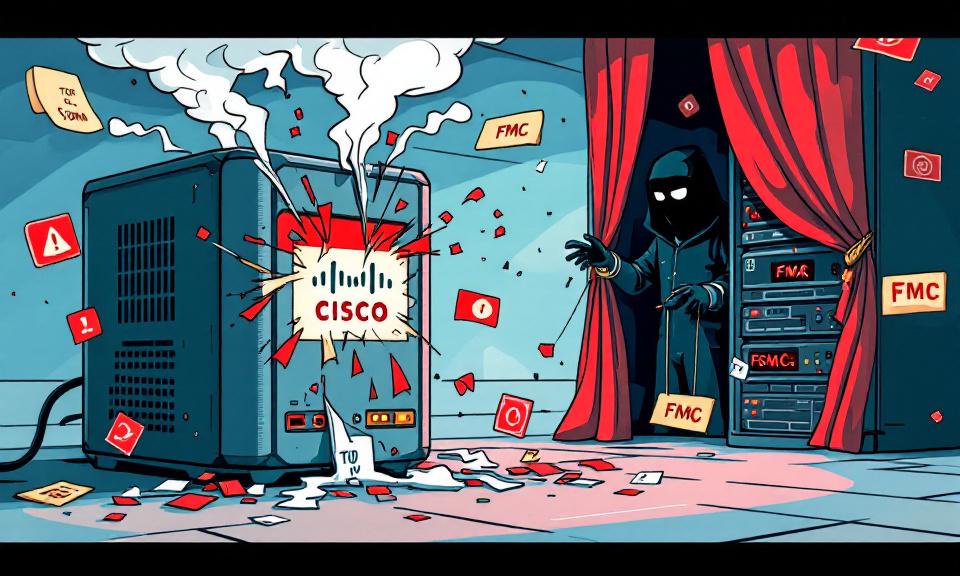
A critical zero-day vulnerability in Cisco Secure Firewall Management Center (FMC) — tracked as CVE-2026-20131 — has been exploited in the wild to deploy Interlock ransomware. The timeline and technical details reported by independent researchers make this a clear, urgent warning for organizations running Cisco FMC: an unauthenticated remote exploit can lead to arbitrary Java code execution with root privileges, and threat actors used it to build a sophisticated, multi-stage intrusion and extortion campaign.
What the vulnerability is and timeline
- CVE-2026-20131 is a flaw in Cisco Secure FMC that allows unauthenticated remote attackers to execute arbitrary Java code as root.
- Cisco publicly disclosed the vulnerability on March 4, 2026.
- Amazon threat intelligence researchers detected exploitation by the Interlock ransomware group beginning January 26, 2026 — roughly 36 days before public disclosure — and shared findings with Cisco.
- Amazon’s investigation reports that AWS infrastructure and customer workloads were not involved in the campaign.
How the exploit was used in the wild
Researchers observed HTTP requests targeting a vulnerable FMC path that attempted remote Java code execution. Successful exploitation triggered actions such as:
- Uploading generated files via HTTP PUT requests.
- Delivery of a malicious Linux ELF binary to staging systems.
- Use of a publicly exposed, misconfigured infrastructure server that revealed the attackers’ full toolkit and individualized staging paths for targets.
Attribution and actor behavior
- Technical indicators and recovered artifacts have been confidently attributed to Interlock, a financially motivated ransomware family active since roughly September 2024.
- Recovered materials included an ELF binary, embedded ransom notes, and a Tor-based negotiation portal consistent with Interlock branding.
- Interlock’s notes emphasize regulatory exposure as coercion — consistent with a double-extortion model (exfiltrate then encrypt).
- Temporal metadata suggests the actors operate in a UTC+3 timezone.
- Historically targeted sectors include education, engineering, construction, manufacturing, healthcare, and government — organizations where operational disruption pressures rapid payment.
Observed tools and tactics
Analysis of the exposed toolkit shows a broad, redundant, and stealth-focused toolset:
- Memory-resident Java webshells using AES-128 encrypted commands with a hardcoded seed to receive instructions via HTTP.
- Custom Java and JavaScript backdoors: the JavaScript implant uses WMI (Windows Management Instrumentation), persistent WebSocket connections, RC4-encrypted messaging, and provides shell access, file transfer, and SOCKS5 proxying; a functionally similar Java backdoor relies on GlassFish libraries.
- A PowerShell enumeration script that collects system details, browser artifacts, and network connections, organizing results per host and compressing them for exfiltration.
- Bash scripts to configure Linux hosts as HTTP reverse proxies (installing HAProxy) and aggressive log-erasure routines (every five minutes) to hinder forensic recovery.
- Abuse of legitimate administrative tools such as ConnectWise ScreenConnect, Volatility for memory forensics, and Certify for Active Directory exploitation, alongside custom implants.
- Heavy customization of downloaded artifacts per target; this reduces the effectiveness of simple hash-based detection.
Operational impact and detection challenges
- Because attackers customized payloads for each victim, file-hash indicators are unreliable; defenders should prioritize behavior-based and memory-centric detection.
- The combination of memory-resident implants, log tampering, and reverse proxies complicates post-compromise investigation and containment.
- Exfiltration followed by encryption (double extortion) increases pressure on incident response and legal/notification obligations.
Immediate mitigation and defensive recommendations
- Apply Cisco’s security updates for CVE-2026-20131 immediately to any affected FMC instances.
- If patching is delayed, isolate FMC appliances from public networks and restrict management-plane access to trusted administrative networks or VPNs.
- Hunt for artifacts and behaviors described above: unusual HTTP PUT activity to FMC endpoints, unexpected ELF binaries, memory-resident Java processes, WebSocket connections from management systems, and rapid log deletion.
- Use endpoint and network detection tools capable of memory analysis and behavioral detection rather than relying solely on signature-based scanners.
- Rotate credentials and review privileged access where FMC or adjacent management systems were accessible.
- Preserve volatile data and logs if you suspect compromise; the attackers’ active log-erasure routines make rapid evidence collection critical.
- Include FMC and other acquired or legacy management tools in routine asset inventories, vulnerability scanning, and patch management workflows.
Conclusion
The exploitation of CVE-2026-20131 by the Interlock ransomware group underscores how quickly a high-impact vulnerability in a critical management product can be weaponized for complex ransomware operations. The combination of pre-disclosure exploitation, memory-resident implants, log tampering, and tailored payloads raises detection and response costs for victims. The factual takeaway is straightforward: apply patches promptly, harden access to management consoles, and shift detection investments toward behavioral and memory-based telemetry to improve the odds of early detection and containment.
 Licensed under CC BY-ND 4.0 International

Ransomware Strikes Colombian Justice Ministry Ahead of Presidential Transition
Colombia's Ministry of Justice was hit by a ransomware attack on August…

Attackers Exploit SharePoint Authentication Bypass After Public PoC Release
Microsoft’s SharePoint platform is facing active exploitation following the public release of…

Akira Ransomware Uses Windows Safe Mode to Shut Down EDR Before Launching Encryptor
Akira’s latest tactics expand the ransomware playbook: instead of relying solely on…

WordPress Imagick RCE (CVE-2026-65640): What Site Owners Need to Know
WordPress has just released a security-focused update — version 7.0.4 — to…