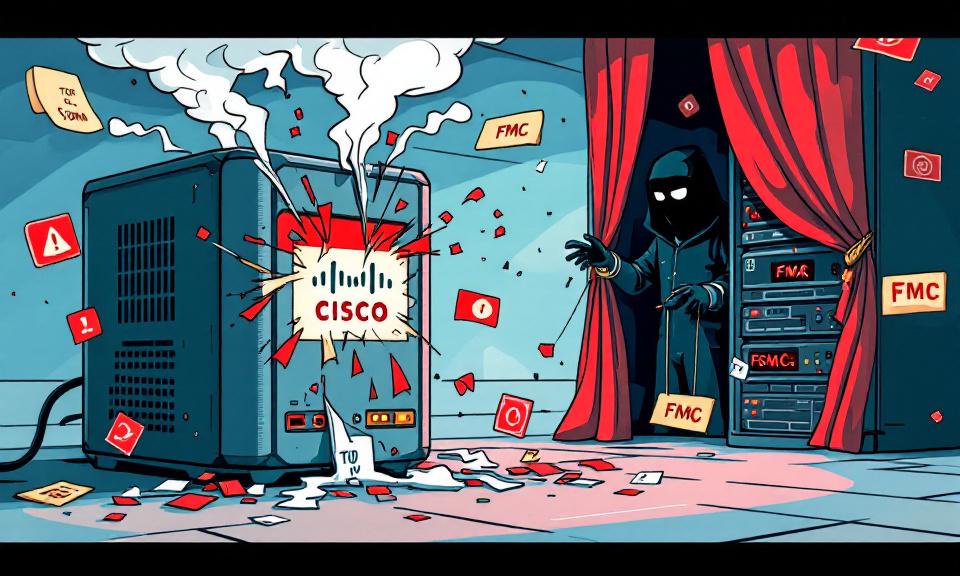
A critical zero-day vulnerability in Cisco Secure Firewall Management Center (FMC) — tracked as CVE-2026-20131 — has been exploited in the wild to deploy Interlock ransomware. The timeline and technical details reported by independent researchers make this a clear, urgent warning for organizations running Cisco FMC: an unauthenticated remote exploit can lead to arbitrary Java code execution with root privileges, and threat actors used it to build a sophisticated, multi-stage intrusion and extortion campaign.
What the vulnerability is and timeline
- CVE-2026-20131 is a flaw in Cisco Secure FMC that allows unauthenticated remote attackers to execute arbitrary Java code as root.
- Cisco publicly disclosed the vulnerability on March 4, 2026.
- Amazon threat intelligence researchers detected exploitation by the Interlock ransomware group beginning January 26, 2026 — roughly 36 days before public disclosure — and shared findings with Cisco.
- Amazon’s investigation reports that AWS infrastructure and customer workloads were not involved in the campaign.
How the exploit was used in the wild
Researchers observed HTTP requests targeting a vulnerable FMC path that attempted remote Java code execution. Successful exploitation triggered actions such as:
- Uploading generated files via HTTP PUT requests.
- Delivery of a malicious Linux ELF binary to staging systems.
- Use of a publicly exposed, misconfigured infrastructure server that revealed the attackers’ full toolkit and individualized staging paths for targets.
Attribution and actor behavior
- Technical indicators and recovered artifacts have been confidently attributed to Interlock, a financially motivated ransomware family active since roughly September 2024.
- Recovered materials included an ELF binary, embedded ransom notes, and a Tor-based negotiation portal consistent with Interlock branding.
- Interlock’s notes emphasize regulatory exposure as coercion — consistent with a double-extortion model (exfiltrate then encrypt).
- Temporal metadata suggests the actors operate in a UTC+3 timezone.
- Historically targeted sectors include education, engineering, construction, manufacturing, healthcare, and government — organizations where operational disruption pressures rapid payment.
Observed tools and tactics
Analysis of the exposed toolkit shows a broad, redundant, and stealth-focused toolset:
- Memory-resident Java webshells using AES-128 encrypted commands with a hardcoded seed to receive instructions via HTTP.
- Custom Java and JavaScript backdoors: the JavaScript implant uses WMI (Windows Management Instrumentation), persistent WebSocket connections, RC4-encrypted messaging, and provides shell access, file transfer, and SOCKS5 proxying; a functionally similar Java backdoor relies on GlassFish libraries.
- A PowerShell enumeration script that collects system details, browser artifacts, and network connections, organizing results per host and compressing them for exfiltration.
- Bash scripts to configure Linux hosts as HTTP reverse proxies (installing HAProxy) and aggressive log-erasure routines (every five minutes) to hinder forensic recovery.
- Abuse of legitimate administrative tools such as ConnectWise ScreenConnect, Volatility for memory forensics, and Certify for Active Directory exploitation, alongside custom implants.
- Heavy customization of downloaded artifacts per target; this reduces the effectiveness of simple hash-based detection.
Operational impact and detection challenges
- Because attackers customized payloads for each victim, file-hash indicators are unreliable; defenders should prioritize behavior-based and memory-centric detection.
- The combination of memory-resident implants, log tampering, and reverse proxies complicates post-compromise investigation and containment.
- Exfiltration followed by encryption (double extortion) increases pressure on incident response and legal/notification obligations.
Immediate mitigation and defensive recommendations
- Apply Cisco’s security updates for CVE-2026-20131 immediately to any affected FMC instances.
- If patching is delayed, isolate FMC appliances from public networks and restrict management-plane access to trusted administrative networks or VPNs.
- Hunt for artifacts and behaviors described above: unusual HTTP PUT activity to FMC endpoints, unexpected ELF binaries, memory-resident Java processes, WebSocket connections from management systems, and rapid log deletion.
- Use endpoint and network detection tools capable of memory analysis and behavioral detection rather than relying solely on signature-based scanners.
- Rotate credentials and review privileged access where FMC or adjacent management systems were accessible.
- Preserve volatile data and logs if you suspect compromise; the attackers’ active log-erasure routines make rapid evidence collection critical.
- Include FMC and other acquired or legacy management tools in routine asset inventories, vulnerability scanning, and patch management workflows.
Conclusion
The exploitation of CVE-2026-20131 by the Interlock ransomware group underscores how quickly a high-impact vulnerability in a critical management product can be weaponized for complex ransomware operations. The combination of pre-disclosure exploitation, memory-resident implants, log tampering, and tailored payloads raises detection and response costs for victims. The factual takeaway is straightforward: apply patches promptly, harden access to management consoles, and shift detection investments toward behavioral and memory-based telemetry to improve the odds of early detection and containment.
 Licensed under CC BY-ND 4.0 International

Atlassian Urges Immediate Patching After Critical Arbitrary File-Access Flaw
Atlassian has released emergency fixes for a critical arbitrary file access vulnerability…

Ransomware Strikes Colombian Justice Ministry Ahead of Presidential Transition
Colombia's Ministry of Justice was hit by a ransomware attack on August…

Vercel Confirms KVM Zero-Day VM Escape, Awards Researcher $50,000
Vercel has publicly acknowledged a reported KVM zero-day that a security researcher…

Critical Dell Container Storage Flaws Expose Admin Controls — Immediate Upgrades Required
Dell’s Container Storage Modules (CSM) were found to contain multiple critical vulnerabilities…

Critical GitLab AI Gateway Flaw: What Administrators Need to Do Now
GitLab has pushed an urgent set of security updates after disclosing a…
Citrix NetScaler Reboots After Emergency 0-Day Patch: What Teams Need to Know
Citrix released emergency builds to address two actively exploited zero-day vulnerabilities in…

Debian Patches 1,313 Kernel Flaws: What Administrators Need to Know
Debian has just released a major kernel security update that aggregates fixes…

Antino: A Stealthy Backdoor That Hides in Outlook and OneDrive
A new espionage campaign tracked by Cisco Talos has exposed a sophisticated…