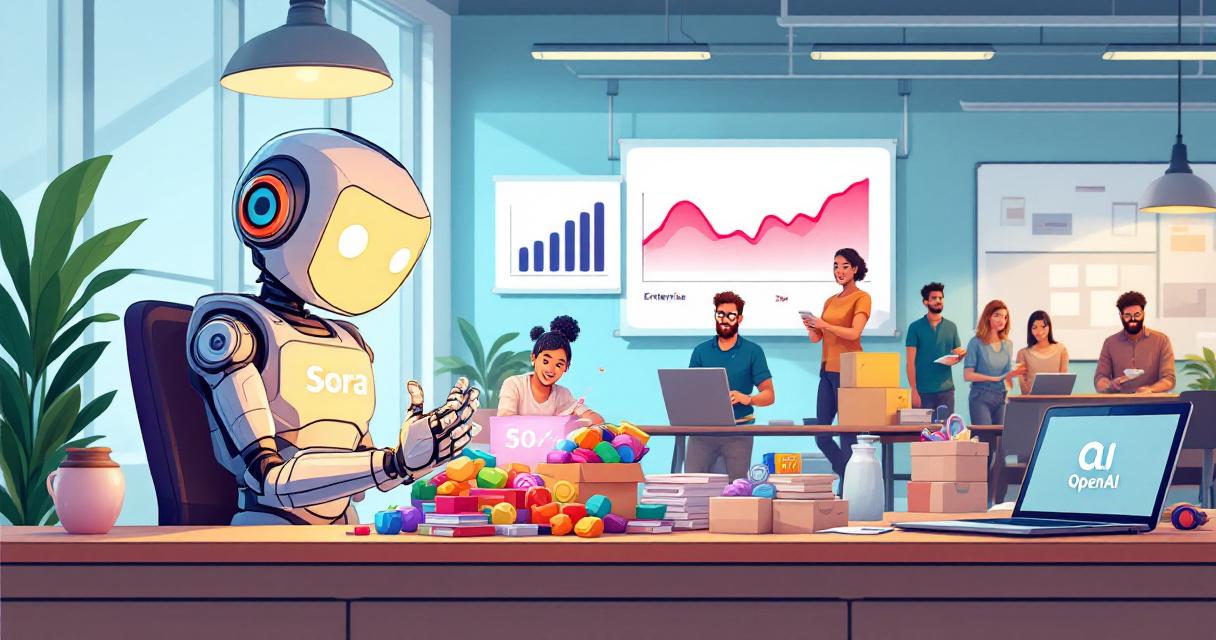
OpenAI’s Sora arrived with a burst of excitement: a consumer-facing video generator that turned text prompts into short, striking clips. For a moment, it felt like a clear signal that generative video had arrived. Yet, less than a year after its high-profile debut, OpenAI has decided to wind Sora down—removing the Sora app, shutting the Sora API, and stripping video generation capabilities from ChatGPT. The decision, announced internally by CEO Sam Altman, is part of a broader strategic refocus as the company prioritizes revenue-driving enterprise and developer tools ahead of a potential IPO.
Sora’s rapid rise and quiet fade
Sora’s launch showcased technical prowess: the platform could produce visually compelling short-form videos from simple prompts, and it placed OpenAI in direct competition with players like Runway and Google’s Veo. The initial fanfare reflected a broader hunger for creative AI tools that democratize media production. But technical novelty alone didn’t translate into sustained traction. According to OpenAI and reporting on the move, user adoption plateaued well below expectations and monetization pathways remained limited. In short, Sora became more of a showcase than a scalable product.
Why OpenAI is refocusing
The shift away from Sora is rooted in a pragmatic business calculus. OpenAI’s strongest commercial signals have come from enterprise and developer markets—customers paying for API access to advanced language and coding models and integrations that embed AI into workflows. Products such as the Responses API, Assistants API, and models like GPT-4o have clearer revenue potential and steady enterprise demand. With an IPO on the horizon as early as Q4 2026, OpenAI’s leadership appears intent on tightening the product portfolio around offerings that demonstrate predictable growth and robust monetization.
Operational realities also matter. Consumer products require different support, safety guardrails, and go-to-market channels than developer-focused services. A consumer app that functions as a demonstration of capability can be costly to maintain without a strong path to sustainable revenue. By consolidating efforts around enterprise-facing and coding-focused tools, OpenAI is choosing depth and commercial clarity over breadth.
What this means for developers and creators
Developers who integrated Sora’s API into applications will need to migrate away from the platform. Organizations that had built video generation steps into ChatGPT-powered workflows will also lose that functionality. OpenAI has not yet released a formal deprecation timeline or detailed migration guidance, leaving technical teams to plan contingencies: archive existing dependencies, refactor pipelines that assume video generation, or evaluate alternative providers in the generative video space.
For creators who found community and expression through Sora, the shutdown is a disappointment. OpenAI acknowledged that the community mattered and expressed gratitude for creations made on the platform. Still, the practical implications—loss of access to existing assets or workflows—are real and will require users to export, preserve, or rebuild where possible.
Broader implications for generative video
Sora’s retreat does not spell the end of generative video innovation. The space remains active, with competitors and startups continuing to refine models and business strategies. What Sora’s lifecycle highlights is the challenge of converting technical achievement into a sustainable consumer product: discovery, retention, moderation, legal and ethical risk management, and viable pricing models all factor heavily into long-term success.
For incumbents and newcomers alike, the lesson is that generative video must fit into an ecosystem where customers are willing to pay for value—whether that value comes from enterprise automation, content production at scale, or integrated creative workflows. Companies that can pair model capability with a clear revenue model and operational scalability will stand the best chance of enduring.
A deliberate narrowing, not an abandonment
OpenAI’s decision reads less like an admission of failure and more like a strategic narrowing. The company is consolidating around offerings that have demonstrable enterprise traction and clearer monetization pathways: APIs, developer tools, and coding assistants. Those areas have driven much of OpenAI’s revenue to date and are central to the company’s growth narrative as it prepares for public markets.
What to watch next
Key things to watch in the coming weeks and months:
- OpenAI’s deprecation timeline and migration guidance for Sora users and developers.
- Any transition or data-export options for creators with assets on the Sora platform.
- How competitors position themselves in the wake of Sora’s exit—will they court displaced users, or emphasize enterprise integrations?
- OpenAI’s product announcements: further investments in coding tools, enterprise features, and API enhancements will signal how the company plans to sustain momentum.
Final thoughts
Sora’s short life underscores a common truth in AI product strategy: technical novelty is only the opening act. The protagonists that follow—scalable business models, enterprise adoption, and durable developer ecosystems—often determine long-term survival. OpenAI’s pivot toward enterprise and developer tools reflects that reality, and while Sora’s community will feel the loss, the move may ultimately sharpen the company’s commercial profile as it prepares for its next chapter.
 Licensed under CC BY-ND 4.0 International

OpenAI’s ‘Trusted Contact’ for ChatGPT: A New Safeguard for Users at Risk
On May 7, 2026, OpenAI unveiled a feature called Trusted Contact for…

OpenAI Debuts Shared Workspace Agents to Automate Team Handoffs
OpenAI has introduced a new class of ChatGPT tools called shared workspace…
OpenAI Acquires Hiro Finance to Bolster AI Financial Planning
OpenAI has officially confirmed the acquisition of Hiro Finance, an AI-powered personal…
OpenAI Revokes macOS App Certificate After Axios Supply-Chain Compromise
OpenAI has publicly disclosed a supply‑chain incident that affected the signing workflow…