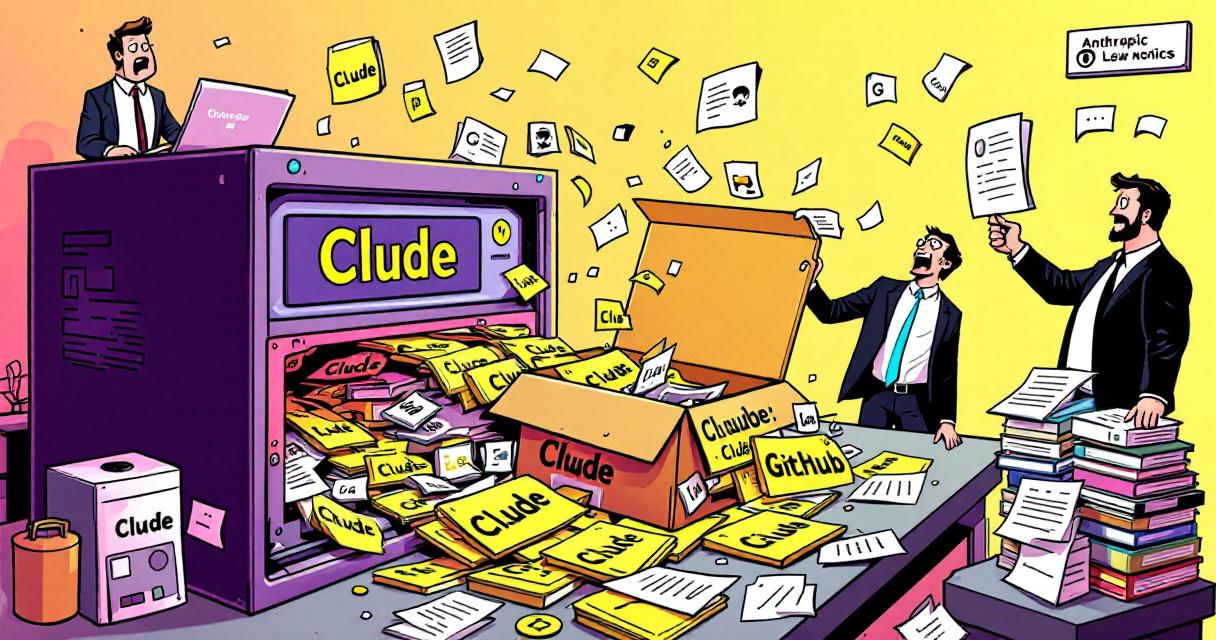
Anthropic has scrambled to contain the fallout after an accidental exposure of the complete source code for its Claude family of AI tools. The company issued roughly 8,000 copyright takedown requests to remove copies and adaptations circulating on code-hosting sites and mirrors, responding to a wave of reposts and forks that appeared within hours of the initial disclosure. Although Anthropic says no customer data or model weights were exposed, the incident reveals how a single operational mistake can cascade into a major intellectual-property and reputational challenge.
How the leak unfolded
The exposure occurred when an npm package update for Anthropic’s Claude Code tool included a 60MB source-map file (cli.js.map) that enabled reconstruction of the tool’s full TypeScript codebase. Security researcher Chaofan Shou identified the file and demonstrated how it could be used to recover the underlying source. Once the source-map was public, copies proliferated quickly: GitHub repositories, mirrors and social posts replicated the code and highlighted internal techniques and implementation details. Anthropic described the incident as a packaging error caused by human mistake, emphasizing that it was not a security breach and that customer data remained secure.
What was revealed
The leaked materials contained commercially sensitive information: CLI implementation details, agent architecture, internal tooling, and specific instructions used to convert AI models into more capable coding agents. Crucially, the model weights and user data were not released. Still, the exposed repository provided a road map to Anthropic’s tooling and design decisions—material that competitors or nascent startups could study to accelerate their own efforts without having to reverse-engineer those behaviors from scratch.
The takedown campaign and immediate response
Faced with rapid replication across platforms, Anthropic filed thousands of takedown requests aimed at hosting services and search engines to suppress copies of the leaked instructions and code. Removing content from the open web is technically and legally messy: platforms apply different standards for copyright claims, and mirrors and forks can persist despite removal efforts. The scale of Anthropic’s takedown activity reflects both the speed at which leaked digital assets spread and the operational burden of trying to reclaim proprietary content.
Commercial and competitive consequences
From a business perspective, the leak erodes part of Anthropic’s competitive moat. The internal tricks and implementation patterns revealed in the source give observers clear clues about what made Claude Code effective, potentially enabling other developers to replicate features more quickly. In addition to immediate commercial risk, the incident could affect investor sentiment and public perception as Anthropic moves toward a high-profile public offering, amplifying scrutiny of the company’s operational controls.
Security and safety considerations
While the absence of model weights and user data reduces some risks, the exposure of architecture and tooling carries safety implications. Internal instructions, prompts, and tool integrations can reveal ways to bypass guardrails or exploit weaknesses in how an agent is orchestrated. For organizations that prioritize responsible deployment, keeping such details private is part of a broader effort to minimize misuse and unexpected harms.
Reputational impact and governance questions
The leak raises questions about engineering and release practices—how packaging and deployment workflows are audited, and what safeguards prevent accidental inclusion of sensitive artifacts. Anthropic’s characterization of the incident as human error, and its pledge to implement corrective measures, underscore the need for stronger operational hygiene in teams that handle high-value code and model artifacts. For customers and partners, such incidents prompt renewed scrutiny of supply-chain and vendor risk management.
What developers and organizations should take away
- Treat provenance seriously: Avoid using or redistributing code that has unclear origins or licensing. Leaked code may carry legal and security liabilities.
- Prefer official sources: Rely on vendor releases and documented SDKs rather than third-party reposts or mirrored packages.
- Harden release processes: Implement checks to detect and exclude source maps, debugging artifacts, or internal tools from public packages.
- Monitor and respond: Keep an eye on vendor advisories and patch releases following any disclosure, and be ready to apply updates or mitigations.
Clarifying what “source code” means
Source code is the human-readable set of instructions that developers write to build software—akin to a recipe that produces the finished product. While users interact with compiled or deployed outputs, the source reveals the precise logic, workflows, and design choices that produce those outputs. That’s why unauthorized exposure of source code can be so consequential for companies that rely on proprietary implementations.
A cautious path forward
Leaks like this one are likely to recur as AI tools grow more sophisticated and organizations ship complex artifacts. The immediate technical fix—removing the offending file from public packages and tightening CI/CD checks—is straightforward; the harder work involves reinforcing organizational practices, revisiting release pipelines, and building resilience so that a single human error does not jeopardize valuable intellectual property or public trust.
Conclusion
Anthropic’s rapid flurry of takedown requests is a stark reminder that operational slip-ups can carry outsized consequences in the AI era. The incident does not appear to have exposed user data or model weights, but it does highlight how engineering mistakes can accelerate competitive erosion, complicate legal enforcement, and prompt difficult choices about disclosure, transparency, and safety. For both vendors and consumers of AI technology, the episode underscores the importance of robust release controls, careful provenance management, and a cautious approach to reusing unverified code.
 Licensed under CC BY-ND 4.0 International

Akira Ransomware Uses Windows Safe Mode to Shut Down EDR Before Launching Encryptor
Akira’s latest tactics expand the ransomware playbook: instead of relying solely on…
2.86 Billion Credentials Flood Criminal Markets — How Infostealers and Initial-Access Brokers Are Reshaping Risk
Stolen login data has become a commodity so abundant that it’s now…
Let’s Encrypt Temporarily Halts Certificate Issuance Following Root Incident
On May 8, 2026, Let’s Encrypt, the widely used non-profit certificate authority,…

Meta inks deal for solar power at night, beamed from space
The race to keep massive AI workloads powered around the clock has…