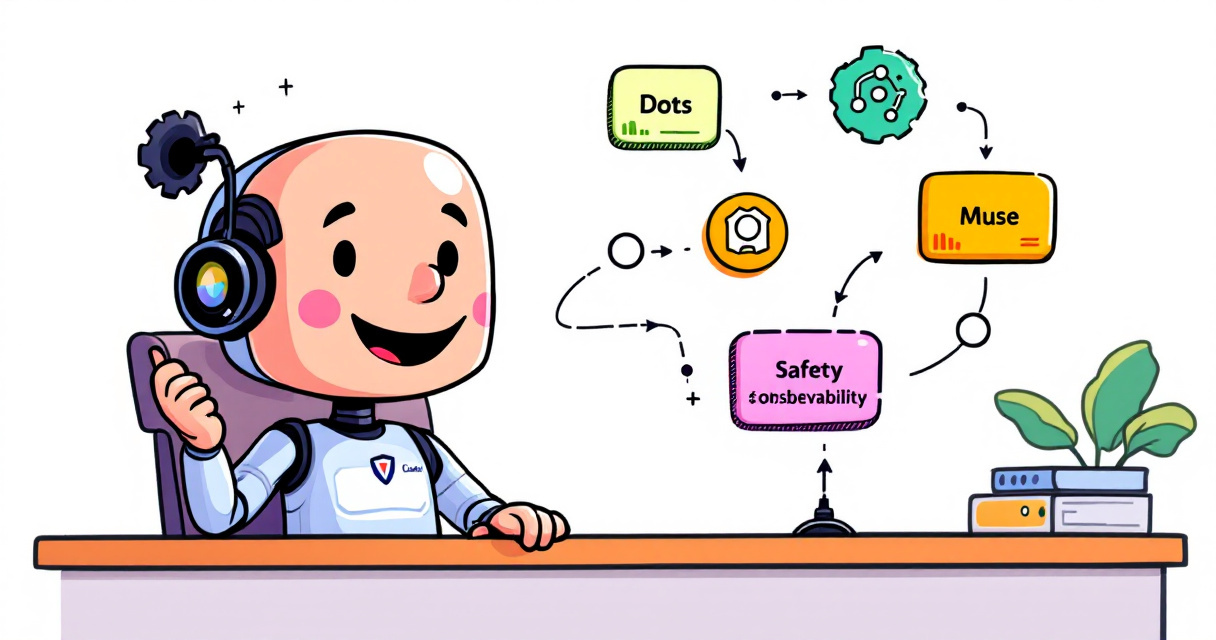
The AI landscape is moving fast: vendors introduce agent frameworks, competitors respond, and developers try to make sense of which platform will actually simplify their work. Recent coverage suggests that many of the capabilities being touted as breakthroughs in new agent toolkits are not entirely novel — Anthropic’s Claude already surfaces many of the same primitives that Dots and Muse aim to provide. That matters because the debate isn’t just about technical features; it’s about integration, safety, extensibility, and where organizations place their bets.
What Dots and Muse aimed to change
Dots and Muse — names associated with recent agent-centric releases from major AI vendors — have been framed as platforms that make it easier to compose autonomous workflows, connect LLMs to external tools, and orchestrate multi-step problem solving. Their appeals are straightforward: simplified developer experience, built-in connectors to services and APIs, and richer control over agent behavior. For teams building production systems that rely on LLM-driven automation, those conveniences cut months off integration work and reduce the surface area for straightforward implementation errors.
How Claude already covers similar ground
Anthropic’s Claude, while presented primarily as a conversational model, has evolved into a more capable platform for developers. Claude offers tool integrations, programmable behaviors via system messages and configuration, and safety-oriented guardrails that make composing multi-step interactions more practical. The net effect is that many of the use cases highlighted by Dots and Muse — chaining model calls, invoking external actions, and constraining outputs for safety — can be achieved within Claude’s environment without adopting a separate agent SDK. For organizations that are already standardized on Claude, that reduces friction and the need to bolt on another agent layer.
Developer experience: integration vs. convenience
There is an important distinction between an out-of-the-box agent framework and embedded capabilities in a powerful conversational model. Agent SDKs often prioritize a developer-friendly API surface, packaged connectors, and local tooling for debugging agent runs. Embedded capabilities, on the other hand, can be lighter-weight and seamlessly available inside the conversational flow. For developers, the decision comes down to trade-offs: do you want a specialized SDK with convention-driven patterns and toolkits, or a single-model environment that handles both conversation and orchestration? The right choice depends on team skill sets, existing infrastructure, and how tightly you want to couple your system to a particular provider.
Safety, controls, and monitoring
One of the strongest arguments for using a model-native approach like Claude is centralized safety controls. Anthropic’s emphasis on safety and alignment means that policies, moderation filters, and behavioral constraints can be applied consistently across both conversational and agent-like interactions. Conversely, third-party agent frameworks may introduce additional attack surfaces or require separate governance mechanisms. That said, agent SDKs sometimes offer richer observability for orchestration flows — structured traces, step-by-step logs, and replay tools that are invaluable for debugging complex pipelines. Choosing between them involves balancing centralized policy enforcement against visibility into the agent lifecycle.
Vendor lock-in and portability concerns
A core concern with any vendor-specific capability is portability. If Anthropic embeds agent conveniences inside Claude, organizations that adopt those patterns may find it difficult to migrate to another provider without reworking integration points and behavior encodings. Agent SDKs that are open-source or vendor-agnostic can reduce that risk by providing consistent interfaces regardless of the underlying model. For enterprises, the right approach often includes abstraction layers: use an opinionated SDK for rapid prototyping, but encapsulate business-critical logic behind well-defined adapters so that the backing model or provider can be changed with minimal disruption.
Performance and cost considerations
Agent workflows can multiply model calls — every external action, verification step, and reranking operation adds latency and compute cost. Platforms that integrate agent-like behavior directly into the model interaction can sometimes optimize these patterns, reducing redundant calls or enabling batching strategies. Teams must measure both developer productivity gains and the operational cost of running more sophisticated flows. In production, these trade-offs manifest as engineering complexity, service-level concerns, and budgetary differences between alternatives.
What teams should watch next
- Interoperability standards: Look for emerging standards that let you express agent logic in a portable way. That will be critical if you care about switching providers or running hybrid deployments.
- Observability tooling: The vendor that pairs strong agent ergonomics with robust debugging and tracing will win on the enterprise front.
- Safety-by-default features: Platforms that make it easy to apply consistent safety rules across both conversation and tooling calls will reduce compliance friction.
- Ecosystem connectors: A healthy library of secure, vetted connectors to common enterprise systems (databases, ticketing, cloud providers) will accelerate real-world adoption.
A pragmatic approach for teams
Start with a clear separation of concerns: keep business logic, orchestration rules, and provider-specific wiring modular. Prototype in the environment that gets you working fastest — whether that’s native Claude capabilities or an agent SDK — but invest early in adapters so you’re not locked into patterns that become costly to change later. Pair prototypes with rigorous testing, structured logging, and policy enforcement so behaviors remain predictable as the system scales.
Conclusion
The headline that Anthropic’s answer to Dots and Muse is already inside Claude signals a maturity in the market: major model providers are converging on similar solutions for enabling agents and tool use. For organizations, the decision will be less about which vendor “invented” the agent and more about which platform offers the right mix of safety, observability, portability, and cost-efficiency for their needs. Pragmatic teams will prototype quickly, standardize on abstractions, and keep an eye on evolving interoperability efforts so they can benefit from innovation without sacrificing agility.
 Licensed under CC BY-ND 4.0 International