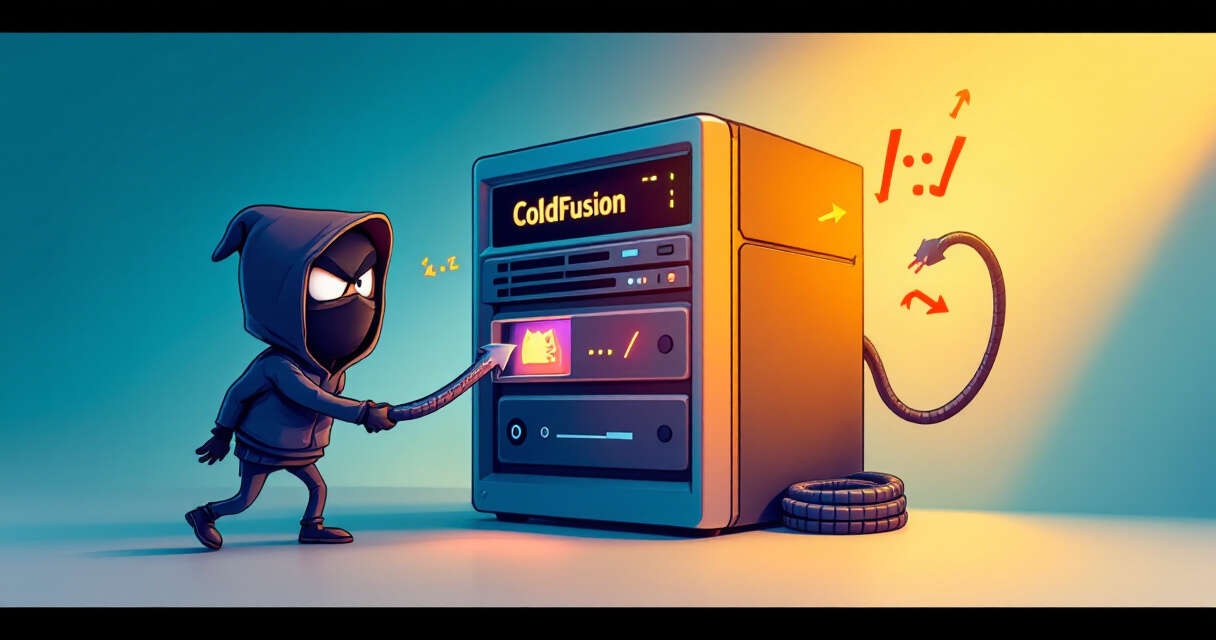
Adobe ColdFusion administrators woke up to an urgent warning this week: a critical path traversal vulnerability (CVE-2026-48282) is being actively exploited in the wild. The U.S. Cybersecurity and Infrastructure Security Agency (CISA) added the flaw to its Known Exploited Vulnerabilities (KEV) catalog on July 7, 2026, and issued a binding remediation timeline for federal agencies under BOD 26-04 that requires action by July 10, 2026. Because ColdFusion is frequently internet-facing in many enterprises, the window for attackers to weaponize this weakness into code execution, web shells, or deeper lateral movement is uncomfortably short.
What the vulnerability is and how it’s exploited
CVE-2026-48282 is rooted in improper limitation of file path inputs (CWE-22), allowing an attacker to manipulate file paths and access restricted directories on a vulnerable ColdFusion server. In practice, threat actors can use this to upload or execute malicious files, read sensitive configuration or credential files, and achieve code execution in the context of the running application. Historically, similar ColdFusion path traversal bugs have been used to establish persistence, deploy web shells, and pivot into internal networks — making this more than a nuisance vulnerability.
Why this matters now
There are three reasons this deserves immediate attention:
- Active exploitation: CISA’s KEV listing signals that attackers already have reliable exploit techniques in the wild.
- Wide exposure: ColdFusion remains deployed across many legacy and modern enterprise environments, often reachable from the internet.
- High impact: Successful exploitation can yield remote code execution and a foothold for data theft, ransomware, or supply-chain attacks.
Immediate steps for defenders
Security teams should prioritize rapid, practical actions to reduce risk:
- Apply vendor patches: Follow Adobe’s official advisories and apply any available patches or hotfixes immediately.
- Restrict external access: Where possible, limit ColdFusion server exposure by applying network access controls, VPNs, or web application firewalls (WAFs).
- Implement temporary mitigations: If patches cannot be applied immediately, use vendor-recommended configuration changes or virtual patching via WAF rules to block exploit paths.
- Enforce least privilege: Review and reduce service and filesystem privileges for ColdFusion processes to limit post-exploitation impact.
- Coordinate with vendors and cloud providers: Ensure cloud-specific guidance from BOD 26-04 is followed, and confirm that provider configurations and controls are correctly applied.
Detection and forensic triage
Early detection reduces the chance of an impactful breach. Recommended detection and triage steps include:
- Review logs: Search web server and ColdFusion logs for unusual file access patterns, unexpected upload activity, or traversal sequences (e.g., ../).
- Hunt for web shells: Scan webroots and temporary directories for recently created or modified files with unusual extensions or content.
- Check for persistence: Look for scheduled tasks, anomalous cron jobs, or unauthorized user accounts that might indicate persistence.
- Collect artifacts: Preserve logs, filesystem snapshots, and memory captures before performing intrusive investigations to support potential incident response and reporting.
- Look for lateral movement: After initial compromise, attackers often attempt to move laterally — review SMB, RDP, and other internal access logs for suspicious activity.
Cloud considerations
Organizations running ColdFusion in cloud environments must map the vendor guidance to cloud controls:
- Confirm network security groups, load balancers, and WAFs are configured to restrict unnecessary external access.
- Apply provider-shared responsibility best practices and any cloud-specific mitigations recommended in BOD 26-04.
- Where adequate mitigations cannot be implemented quickly, consider decommissioning or isolating affected instances until they can be patched.
Risk management and long-term hardening
Beyond short-term remediation, teams should treat this incident as a reminder to harden web platforms:
- Reduce internet exposure for legacy platforms or migrate off unsupported ColdFusion instances.
- Adopt a proactive patching cadence and automated vulnerability management to shrink the window between disclosure and remediation.
- Use robust WAF rulesets, runtime application self-protection (RASP) where available, and continuous monitoring for anomalous application behavior.
- Conduct periodic threat modeling and tabletop exercises that include web-facing middleware such as ColdFusion.
Timeline and compliance
CISA added CVE-2026-48282 to its KEV catalog on July 7, 2026, and federal agencies are required under BOD 26-04 to apply patches or mitigations by July 10, 2026. Private-sector organizations should treat that timeline as an urgent best practice rather than a guideline: with active exploitation confirmed, delay substantially increases the risk of compromise.
Conclusion
CVE-2026-48282 is a serious path traversal vulnerability with confirmed exploitation and a rapid remediation mandate for federal systems. Administrators should act now: patch where possible, restrict external access, hunt for indicators of compromise, and apply cloud-specific controls. Treat this event as a broader signal to accelerate hardening and reduce the public attack surface of legacy and internet-facing web platforms.
 Licensed under CC BY-ND 4.0 International