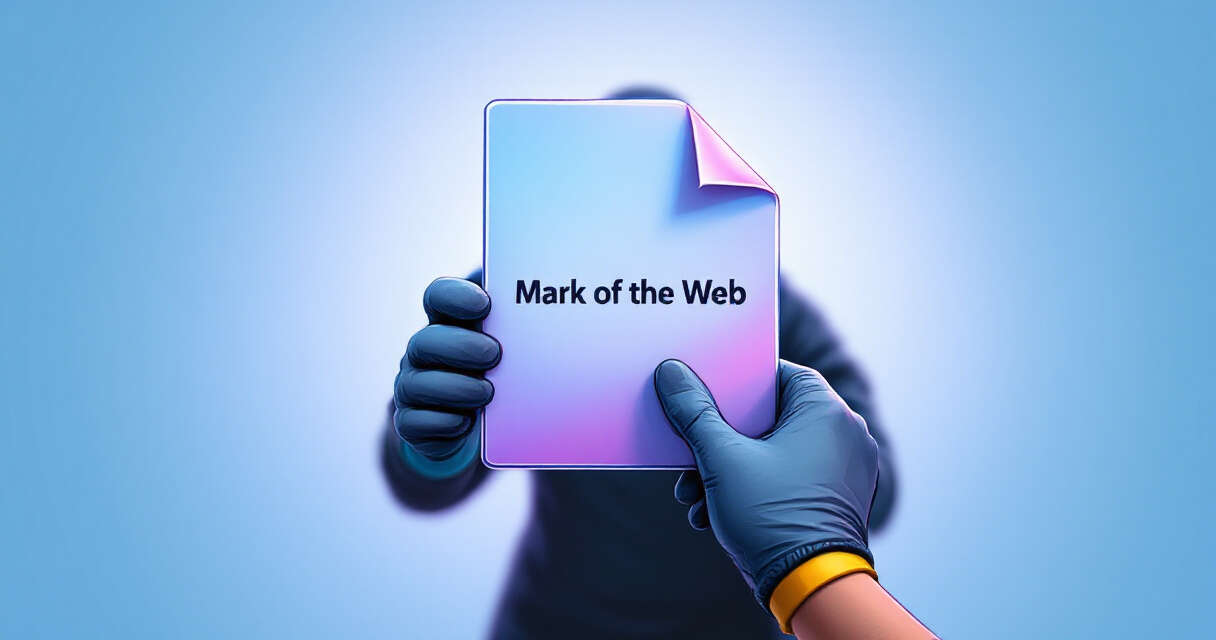
Microsoft released an urgent patch in the October 2026 Patch Tuesday cycle to address an actively exploited Windows Shell zero-day that allows attackers to bypass Mark of the Web (MOTW) protections. Tracked as CVE-2026-96951 and rated Important with a CVSS score of 8.8, Microsoft confirmed exploitation had already occurred when the update shipped. The vendor’s “Exploitation Detected” assessment raises this from a theoretical risk to an immediate operational concern for defenders and administrators.
What Microsoft fixed
Microsoft’s update closes a command-injection flaw in Windows Shell that fails to properly handle certain special elements in a command. The result, as described by Microsoft, is a security feature bypass that can be triggered over a network by an unauthenticated attacker. While the vulnerability is classified as a bypass of protections rather than a direct remote code execution vulnerability, its ability to strip MOTW flags makes downstream attacks far easier: once MOTW is removed, files originating from the internet no longer carry the warning and may not trigger other defensive checks when opened.
How the vulnerability works
At a technical level, the flaw involves Windows Shell’s handling of special elements used in commands. An attacker can craft a file that, when delivered to a target and opened with user interaction, triggers behavior that evades MOTW. Delivery vectors are straightforward: attackers can embed the malicious payload in email attachments, instant messages, or other files that users are likely to open. Because successful exploitation requires the user to open or otherwise interact with the malicious content, this is not a zero-click attack; social engineering remains the primary enabling factor.
Why Mark of the Web matters
Mark of the Web is an important security signal Windows uses to identify files downloaded from the internet and to apply warnings, sandboxing, or reduced trust. Bypassing MOTW removes a visible and programmatic barrier that gives users and automated defenses a chance to block or flag risky content. The industry has seen similar bypass techniques before: Windows LNK “stomping” attacks have been used to strip MOTW from shortcuts, and weaknesses in archive extraction (for example, some WinZip behaviors) have historically caused internet-origin tags to be lost. Those earlier issues differ in mechanics from CVE-2026-96951 but highlight a broader class of attacks that try to defeat origin-based protections.
Attribution and what remains unknown
Microsoft’s advisory credits Riku Bamba and Yuya Chudo of Fujitsu Limited, Benoit Sevens (using Claude with Anthropic), and researcher yhw for reporting the issue. The advisory does not identify who exploited the vulnerability, which organizations or sectors were targeted, the specific malicious file format used in observed attacks, or the scale of exploitation. Those gaps limit what defenders can infer about attacker motives, tooling, and indicators of compromise; they also reinforce the need for rapid patching rather than relying solely on threat intelligence to triage risk.
What this means for defenders and IT teams
Because Microsoft marked the vulnerability as “Exploitation Detected,” organizations should treat the fix as high priority. Even though exploitation requires user interaction, the removal of MOTW increases the success probability for socially engineered lures. Detection tools like EDR can surface artifacts of an attack, but telemetry and alerts may not reconstruct the full chain or reveal every affected host without proactive hunting. Security teams should rapidly identify affected systems, test the update in staging to confirm compatibility, and deploy the patch broadly.
Practical steps to reduce risk
– Apply the October 2026 Microsoft updates immediately to all affected Windows endpoints and servers after confirming compatibility in your environment.
– Consult Microsoft’s Security Update Guide to identify which products and builds are affected and to track deployment status.
– Hunt in endpoint telemetry and EDR for signs of suspicious file opens, unexpected command executions from user context, or any activity that correlates with file delivery vectors (e.g., email attachments opened shortly before anomalous shell activity).
– Reinforce email and messaging defenses: enable attachment scanning, block high-risk file types where feasible, and apply sandbox detonation for suspicious attachments.
– Tighten user-facing policies: warn users explicitly about opening unexpected attachments, and consider removing or limiting the automatic association of risky file types with powerful applications.
– Review archive extraction and shortcut handling policies and tools—ensure extraction preserves origin tags where possible and consider automated scanning of extracted content.
– Keep threat intel channels open but act on the patch even if attribution and full campaign details remain unknown.
Conclusion
CVE-2026-96951 is a timely reminder that security features designed to give defenders and users contextual signals—like Mark of the Web—can themselves be attractive targets for attackers. The confirmed exploitation elevates urgency: apply Microsoft’s update quickly, validate across your environment, and combine patching with detection and user-awareness measures to reduce the window of exposure. Even when a flaw doesn’t directly yield remote code execution, weakening of protective layers can materially increase risk when paired with social engineering.
 Licensed under CC BY-ND 4.0 International