
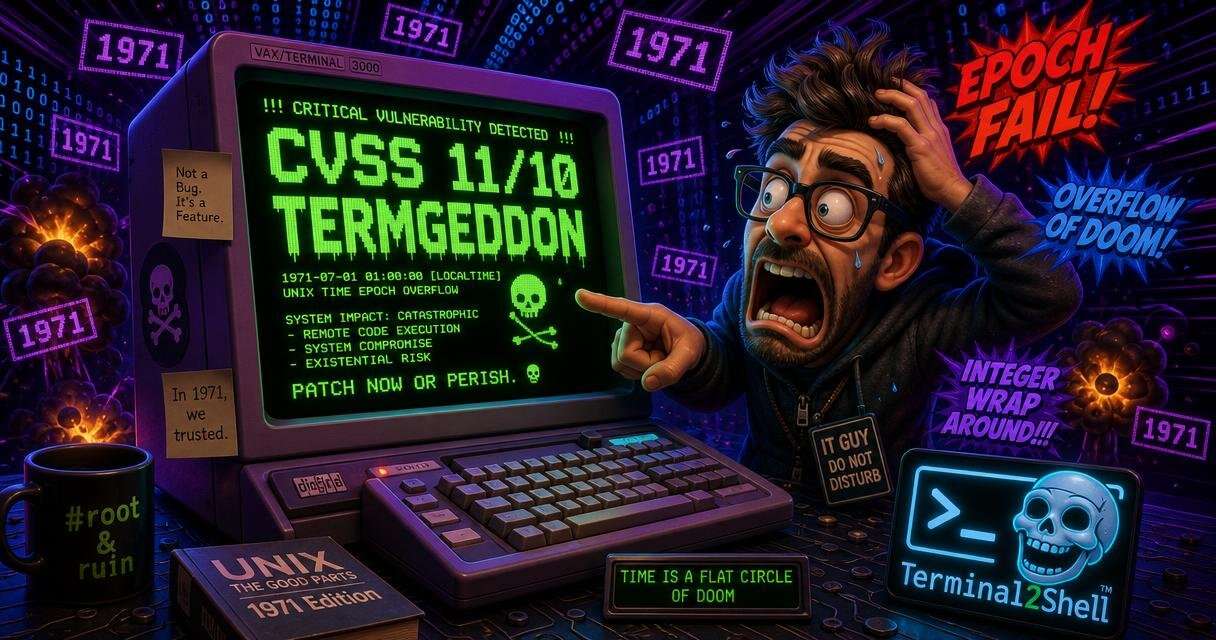
Terminal2Shell says a flaw dating back to 1971 affects more than two billion devices and lets anyone who opens a terminal gain an interactive shell. The page presents the issue as “TermGeddon,” but it is satire rather than a confirmed vulnerability disclosure.
The supposed issue and what it actually shows
The site lists a CVE as pending and gives the problem a CVSS score of 11.0 out of 10. That score exceeds the official CVSS scale, which stops at 10.0. The claim about billions of affected devices therefore should not be treated as verified.
Its description says the attack needs local access, a keyboard, and the ability to open a terminal. It then gives the person the permissions of the account already signed in. Nothing in that description shows an authentication bypass, remote compromise, or access to another user’s account. The claimed attack begins with access the person already has.
Terminal2Shell treats normal terminal use as if it were a security flaw. A shell is a way to enter commands, while a flaw has to do more than show that commands run when an authorized user types them. The site uses alarming labels and a branded page to make ordinary behavior sound dangerous.
How the claim differs from real shell exploits
The page draws a contrast with Able2Shell, where N-able took hosted N-central servers offline after reports of 33 alleged vulnerabilities and published exploit code. Huntress identified four exploit chains, including three that led to remote code execution. Those cases involved attackers gaining control through weaknesses in management software, unlike opening a terminal on a system the user already controls.
Plex2Shell shows a different pattern. Attackers reportedly used a chain of Plex flaws to install cryptocurrency miners shortly after exploit code became public. The fixed release named in the coverage is Plex Media Server 1.43.3.10861. The installed version matters because a server can still appear to work normally while remaining exposed.
PHP2Shell involved another step beyond the first foothold. Researchers reported that attackers combined it with a Linux kernel flaw to obtain root access on 25 servers. Updating the application alone would not address a separate weakness in the underlying operating system.
HTTP2Shell and Node2Shell concern a Brotli decoding flaw rather than ordinary command entry. Reported effects vary across affected software and include crashes and demonstrated code execution. For Node.js, the fixed releases listed are 22.23.4, 24.22.1, and 26.12.1. A shared component does not mean every affected product follows the same attack path.
WP2Shell reportedly lets attackers create WordPress administrator accounts and install web shells without signing in. That missing login requirement marks a security boundary being crossed. The fixed releases listed are WordPress 6.8.6, 6.9.5, and 7.0.2.
What the Terminal2Shell page leaves out
The Terminal2Shell claim does not show an attack that crosses a security boundary. It does not establish a new vulnerability, and it does not justify emergency patching based on the behavior it describes. Its own wording says the user already has the access being “obtained.”
The useful test is who controls the shell, what access was needed before it opened, and whether the action changes privileges or reaches another account. Terminal2Shell fails that test on its own description, because it presents expected behavior as a discovery.
 Licensed under CC BY-ND 4.0 International