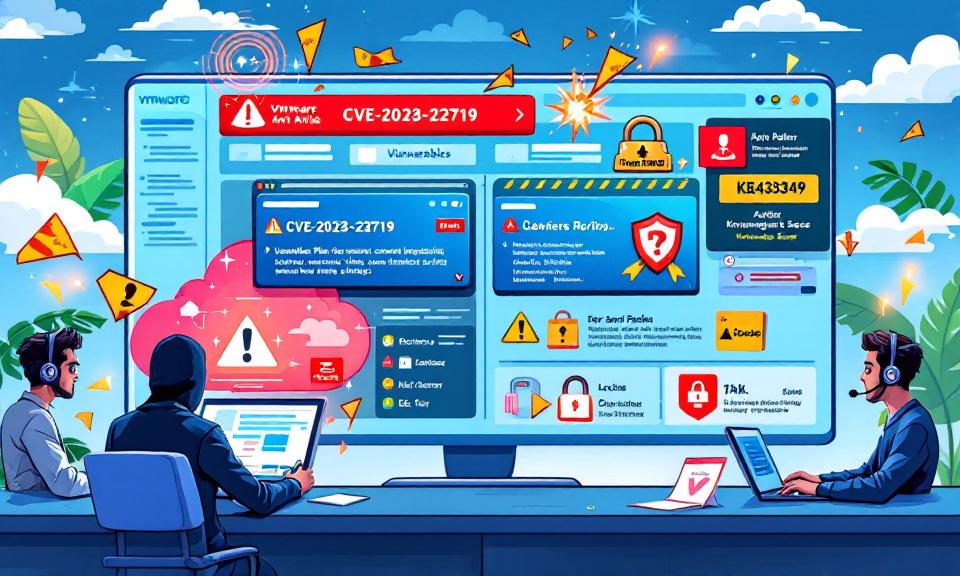
VMware’s Aria Operations — a cornerstone for many organizations’ cloud and infrastructure management — was thrust into the spotlight this week after Broadcom published VMSA-2026-0001, detailing three significant vulnerabilities. These flaws range from command injection that can lead to full remote code execution, to stored cross-site scripting that enables administrative actions, and a privilege escalation path from vCenter to Aria Operations. If you run Aria Operations as part of VMware Cloud Foundation, Telco Cloud Platform, or Telco Cloud Infrastructure, this is a moment to move quickly and deliberately.
What happened
Broadcom disclosed three CVEs affecting VMware Aria Operations:
- CVE-2026-22719: A command injection vulnerability exploitable by unauthenticated actors during support-assisted product migrations, rated with a high severity. This is the most critical of the three because it can lead to arbitrary command execution on affected systems during a routine operational process.
- CVE-2026-22720: A stored cross-site scripting (XSS) issue tied to custom benchmark creation. Privileged users can inject scripts that execute administrative actions, effectively weaponizing UI features.
- CVE-2026-22721: A privilege escalation flaw that allows users with vCenter access to escalate their privileges to administrator level within Aria Operations.
Broadcom’s advisory maps affected versions and the fixes. Patches are available — for example, Aria Operations 8.18.6 and VMware Cloud Foundation 9.0.2.0 contain fixes — and a workaround documented as KB430349 can mitigate CVE-2026-22719, though no workarounds exist for the other two issues.
Why this matters
The trio of vulnerabilities presents a layered threat. An unauthenticated command injection in an enterprise management plane can lead to immediate and severe outcomes: attackers could run arbitrary code, pivot to other systems, exfiltrate data, or deploy ransomware. Coupled with stored XSS that allows administrative actions and a path for privilege escalation from vCenter to Aria, the risk surface expands from crafty web-based attacks to full operational compromise.
Many organizations run Aria Operations embedded in broader VMware platforms. That integration amplifies the potential impact because a compromise can cascade across cloud foundations and telco platforms, touching orchestration, networking, and service management layers. In environments where migrations or vendor-assisted support activities are frequent, the window for exploitation increases.
Who is affected
Affected deployments include, but may not be limited to:
- VMware Aria Operations 8.x and earlier bundled versions.
- VMware Cloud Foundation distributions (various 9.x/5.x/4.x bundles).
- Telco Cloud Platform and Telco Cloud Infrastructure bundles across affected versions.
Administrators should consult the advisory and the provided product matrix to confirm if their specific deployments are vulnerable. If you’re unsure, treat your Aria Operations instances as potentially impacted until verified.
Immediate steps administrators should take
- Identify all Aria Operations instances and any VMware products that bundle Aria Operations in your environment.
- Prioritize systems exposed to untrusted networks or those that undergo frequent migrations or support-assisted operations.
- Apply fixes and workarounds
- Review Broadcom’s VMSA-2026-0001 advisory and install the official patches where they’re available (for example, upgrade to Aria Operations 8.18.6 or the corresponding fixed Cloud Foundation bundle).
- If you cannot immediately patch, apply the recommended workaround KB430349 for CVE-2026-22719 and follow any temporary mitigations provided for other components.
- Harden access and limit exposure
- Restrict administrative interfaces to trusted networks and management VLANs. Ensure that vendor-assisted operations require authenticated, logged channels.
- Enforce the principle of least privilege for Aria and vCenter users; tightly control who can create custom benchmarks or perform migrations.
- Monitor and hunt for indicators
- Increase logging and monitoring around Aria Operations, vCenter, and any migration activities. Look for abnormal commands, unexpected benchmark creations, or sudden privilege changes.
- Run focused threat hunting for signs of command execution, new persistent backdoors, or changes to configuration and admin accounts.
- Deploy application and network protections
- If available, enable web application firewalls (WAFs) to help filter malicious payloads targeting stored XSS vectors until full patches are in place.
- Segment management planes from production workloads to minimize lateral movement opportunities.
- Validate and test updates
- Patch in a staged manner: test updates in non-production first, validate compatibility with integrations and toolchains, then schedule production deployments with rollback plans.
- Prepare incident response
- Update runbooks to include these vulnerabilities. If you detect exploitation, preserve logs, isolate affected systems, and follow your incident response plan. Notify stakeholders as required by policy or regulation.
Longer-term lessons
This advisory underscores a few recurring themes for infrastructure and cloud platform security:
- Management and orchestration layers are high-value targets. Security posture for these components should be as robust as the services they manage.
- Third-party or vendor-assisted operational workflows can introduce unexpected attack vectors. Operational procedures need to consider adversarial misuse.
- Regular inventory and rapid patching workflows are essential. Having a clear asset register, automated patch testing, and deployment pipelines reduces the window of exposure.
Conclusion
The VMware Aria Operations vulnerabilities disclosed in VMSA-2026-0001 are an urgent call-to-action for administrators and security teams. With the potential for unauthenticated command execution and pathways to elevated administrative control, organizations must inventory affected systems, apply patches or workarounds immediately, and tighten controls around management interfaces and migration processes. Vigilant monitoring and readiness to respond will be critical in the days following this disclosure.
Credits
Research and reporting credited to Tobias Anders (Deutsche Telekom Security), Sven Nobis, and Lorin Lehawany (ERNW), and to Broadcom/VMware for the advisory.
 Licensed under CC BY-ND 4.0 International

Microsoft Extends Windows 10 Extended Security Updates Through October 2027
Microsoft has quietly extended its consumer Extended Security Updates (ESU) program for…
The Credential-Free Watchdog: Mastering Event-Driven App Automation
We have all been there. You are an automation lover. You have…

Copy Fail (CVE-2026-31431): A 4‑Byte Kernel Bug That Lets Attackers Gain Root on Major Linux Distros
Microsoft Defender Security Research recently disclosed CVE-2026-31431—nicknamed “Copy Fail”—a high‑severity local privilege…

Attackers Exploit VMware vCenter Vulnerability to Gain Persistent Remote Access
A newly disclosed critical flaw in VMware vCenter (CVE-2026-59310) has moved quickly…