
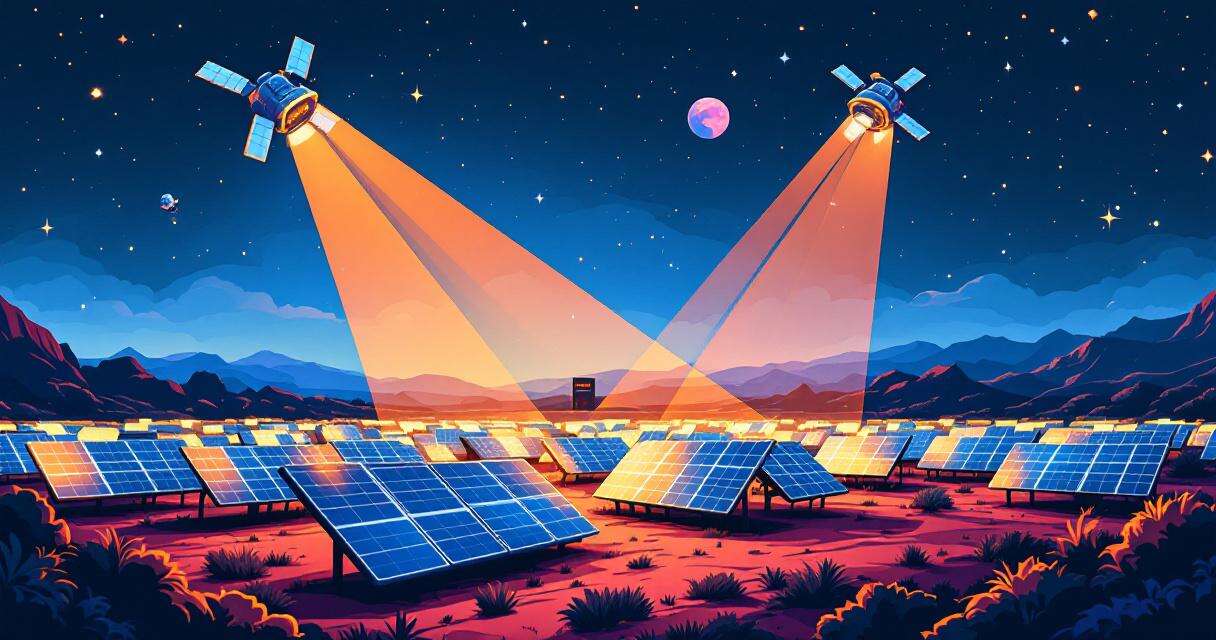
The race to keep massive AI workloads powered around the clock has led Meta to sign a capacity reservation agreement with Overview Energy, a startup developing spacecraft that collect solar energy in space and convert it to near-infrared light beamed at large terrestrial solar farms. The deal — for up to 1 gigawatt of capacity — is a notable early commercial commitment for a technology that, if it scales, could change how solar infrastructure delivers power during evening and night hours.
How the system works
Overview’s concept is to harvest sunlight in space, convert it into infrared light, and transmit that light as a wide beam to existing ground-based solar farms. Those farms would then convert the incoming infrared photons back into electricity using their existing photovoltaic installations. Overview calls its new unit of sale “megawatt photons,” representing the amount of light needed to generate a megawatt of electricity on the ground. The company has already demonstrated power transmission from an aircraft and plans an initial satellite demonstration from low Earth orbit in January 2028.
Why Meta is buying capacity
Meta’s data centers consumed more than 18,000 gigawatt-hours of electricity in 2024, and its appetite for compute — and therefore reliable power — only continues to grow. The company has a stated goal of building 30 gigawatts of renewable power capacity. A subscription or reservation for space-delivered infrared light gives Meta a potential way to extend the value of large daytime solar installations into the evening without relying solely on battery storage or fossil-fuel-backed backup generation.
Technical and safety claims
Overview positions its approach as avoiding the high-power laser or microwave strategies that have historically raised safety and regulatory concerns. The company’s CEO, Marc Berte, has asserted the infrared beams would be safe to look at directly. The system’s real-world safety, electromagnetic environment impacts, and operational constraints will need independent verification and regulatory review before large-scale deployment. The use of a wide beam, rather than a tightly focused laser, is a central part of Overview’s pitch for reduced risk.
Regulatory, logistical and economic hurdles
Deploying a fleet of power-transmission satellites raises multiple challenges. Regulators will need to evaluate airspace and orbital safety, terrestrial optical exposure standards, and potential interference with astronomy and remote sensing. On the logistics side, the plan to field hundreds or thousands of satellites requires large launch cadence, orbital coordination, and maintenance strategies. Economically, space-to-ground transmission must be cost-competitive with other options — grid upgrades, long-duration storage, demand-response measures, or simply building more daytime generation paired with batteries.
Timeline and proposed scale
Overview told TechCrunch it expects to begin launching satellites to fulfill its commitments in 2030, with a longer-term objective of operating roughly 1,000 spacecraft in geosynchronous orbit. The company says each satellite would be capable of providing power for more than a decade, and an initial deployment could cover roughly a third of the planet — from the U.S. West Coast across to Western Europe. The near-term milestone is the planned 2028 low Earth orbit transmission demonstration, which will be watched closely by potential customers and regulators alike.
What this could mean for energy and AI
If Overview’s approach proves technically and commercially viable, space-sourced illumination could change the economics of large solar farms by improving their effective capacity factor after sunset. For hyperscalers like Meta, that could reduce dependence on batteries or fossil fuel backup and create more predictable, renewable-backed power for compute-heavy AI operations. But widespread adoption hinges on resolving technical uncertainties, acquiring regulatory approvals, lining up launches at scale, and proving a reliable business model that accounts for both satellite and ground-side costs.
 Licensed under CC BY-ND 4.0 International