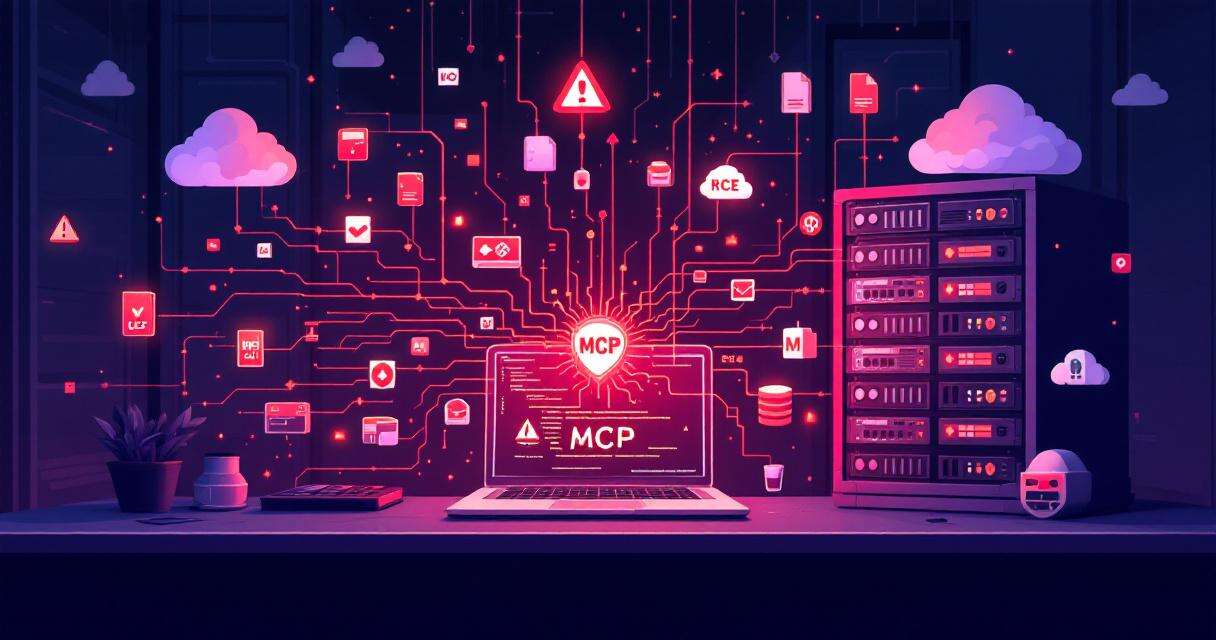
A critical architectural flaw in Anthropic’s Model Context Protocol (MCP) ecosystem has exposed a vast number of downstream systems to remote code execution (RCE) risks. Researchers at OX Security found the issue embedded across official MCP SDKs for Python, TypeScript, Java, and Rust — meaning developers building on MCP inherit the vulnerability by design rather than through a simple coding bug. The implications are severe: arbitrary command execution, data exfiltration, and the potential for complete system takeover on vulnerable deployments.
What the vulnerability is
OX Security describes the problem as a fundamental design decision in MCP implementations that allows untrusted inputs to influence STDIO-like parameters and execution contexts. When exploited, the flaw permits Arbitrary Command Execution on systems running a vulnerable MCP implementation. Attackers who successfully exploit the vulnerability can access internal databases, API keys, chat histories, and other sensitive artifacts, effectively gaining full control of the affected environment.
How researchers proved it
The team demonstrated practical exploitation in the wild, confirming command execution on six live production platforms. Their research identified multiple exploitation families rather than a single attack vector, which increased the severity and breadth of potential impact across varied use cases and toolchains.
Exploitation families and attack vectors
- Unauthenticated UI Injection targeting popular AI frameworks and tools.
- Hardening bypasses that defeat protections in hardened environments like Flowise.
- Zero-click prompt injection within AI-focused IDEs such as Windsurf and Cursor.
- Malicious marketplace distribution, where researchers report 9 of 11 MCP registries were successfully poisoned with a test payload.
Scope and affected projects
The exposure is widespread: MCP implementations have been downloaded more than 150 million times, and researchers estimate up to 200,000 servers could be vulnerable depending on deployment choices. The research produced at least 10 CVEs across multiple high-profile projects. Several critical issues have already been patched (for example, CVE-2026-30623 in LiteLLM and CVE-2026-33224 in Bisheng), but a number of high-impact projects remained in a reported, unpatched state at the time of disclosure — including GPT Researcher, Agent Zero, Windsurf, and DocsGPT.
Vendor response and disclosure timeline
OX Security says they recommended a protocol-level patch to Anthropic that would have immediately mitigated the exposure for millions of downstream users. Anthropic declined that protocol-level change, characterizing the observed behavior as “expected,” and did not object to public disclosure. The episode arrived days after Anthropic announced Claude Mythos, underscoring the contrast between public claims about AI security and the need to apply “secure by design” principles to foundational infrastructure.
Practical mitigations for organizations
- Block public internet access to any AI service that connects to sensitive APIs or databases.
- Treat all external MCP configuration input as untrusted; disallow user-controlled inputs that map directly to STDIO or execution parameters.
- Install MCP servers only from verified, trusted sources (for example, the official MCP GitHub registry) and verify package integrity.
- Run MCP-enabled services inside strong sandboxes and least-privilege containers to limit blast radius.
- Monitor tool invocations and background activity for signs of unexpected execution or data exfiltration.
- Update affected libraries and tools immediately when patches are released; prioritize components with published CVEs.
Recommendations for developers and security teams
Security teams should inventory their use of MCP-enabled frameworks and libraries, prioritize systems that expose sensitive data or secrets, and apply mitigations even where vendor patches are not yet available. Developers should treat MCP-derived input the same way they would any untrusted runtime argument and avoid designs that forward user-controlled values into execution contexts. Where possible, isolate model-serving components from core infrastructure and secrets stores using dedicated service accounts and strictly scoped credentials.
Why this matters for the broader AI ecosystem
This vulnerability highlights a recurring tension in the AI tooling ecosystem: rapid innovation and wide reuse of libraries can amplify a single design decision into systemic risk. Protocol-level exposures are especially dangerous because they propagate through the supply chain and can be difficult to remediate comprehensively without coordinated, upstream fixes. The incident is a prompt for vendors and standards bodies to prioritize secure-by-default behaviours in protocols and SDKs that sit at the foundation of AI development.
Conclusion
The MCP vulnerability discovered by OX Security is a reminder that architectural choices can have cascading security consequences across millions of installations. Organizations should assume that MCP-based components may be in their software supply chain, act quickly to audit and contain exposure, and apply layered defenses while vendors and maintainers implement protocol and library-level fixes. Rapid patching, strict input validation, sandboxing, and limiting network exposure remain the most effective ways to reduce risk while the ecosystem works toward more robust protocol defaults.
 Licensed under CC BY-ND 4.0 International