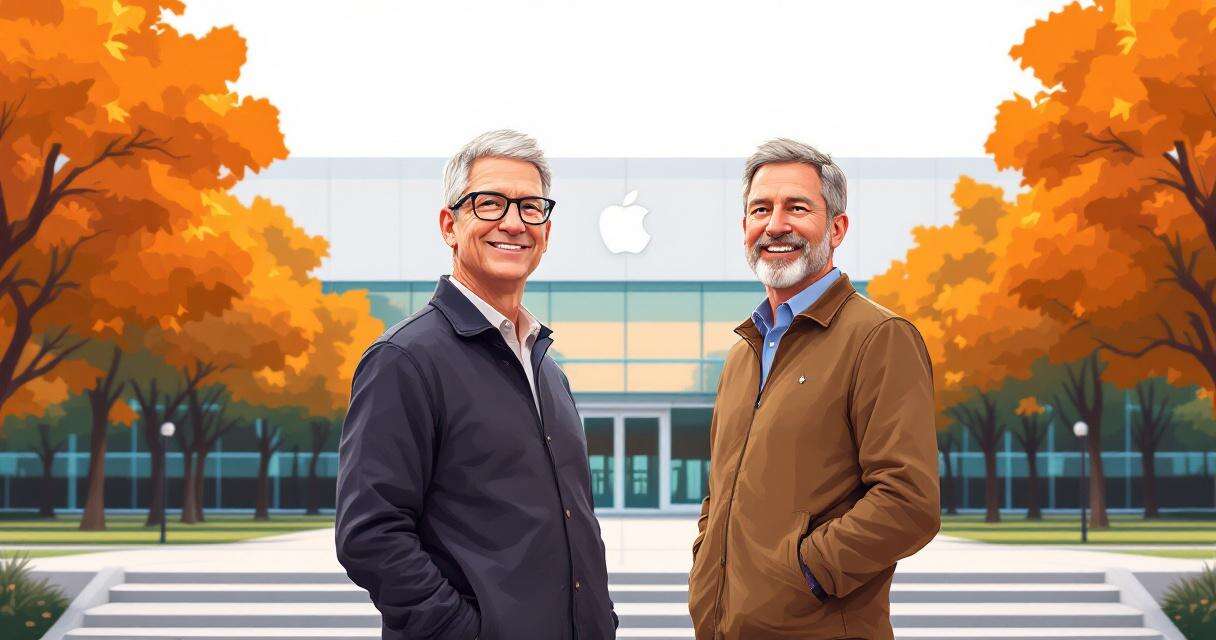
Apple has announced a major leadership transition: Tim Cook will become executive chairman of Apple’s board of directors, and John Ternus, currently senior vice president of Hardware Engineering, will step into the role of CEO on September 1, 2026. The board approved the change unanimously after a long-term succession planning process. Cook will remain CEO through the summer to work directly with Ternus on a smooth handover.
A planned, orderly succession
This move reflects deliberate succession planning rather than a sudden change. Apple’s board and executive team have prepared for long-term continuity, and the transition timeline allows Cook to guide Ternus through operational and strategic responsibilities during the summer months. Arthur Levinson, Apple’s non-executive chairman for the past 15 years, will shift to lead independent director, and Ternus will join the board effective September 1.
Tim Cook’s legacy and responsibilities ahead
Tim Cook’s tenure as CEO, beginning in 2011, oversaw enormous growth in both products and scale: Apple expanded its market capitalization from roughly $350 billion to about $4 trillion and grew annual revenue from $108 billion in 2011 to over $416 billion in FY2025. Under his leadership Apple launched major new categories and services—Apple Watch, AirPods, Apple Vision Pro, iCloud, Apple Pay, Apple TV, Apple Music—and drove the company’s transition to Apple-designed silicon. Cook also emphasized corporate values: sustainability initiatives that reduced Apple’s carbon footprint by more than 60% below 2015 levels, strong privacy protections, expanded accessibility features, and global retail and workforce growth. As executive chairman, Cook will continue to support the company, including by engaging with policymakers worldwide.
Who is John Ternus?
John Ternus joined Apple’s product design team in 2001 and rose through engineering leadership to become vice president of Hardware Engineering in 2013 and a member of the executive team as senior vice president in 2021. He has overseen hardware engineering across Apple’s product lines—iPhone, iPad, Mac, Apple Watch, and AirPods—and led innovations in durability, materials, repairability, and environmental impact, such as development of recycled aluminum compounds and use of 3-D printed titanium. Ternus’s team recently shipped notable products that reshaped their categories, including advancements in Mac performance and the introductions of the MacBook Neo and iPhone 17 lineup. His technical depth and long tenure at Apple are central to why the board selected him as CEO.
Board and governance adjustments
Arthur Levinson will move from non-executive chairman to lead independent director, a role that typically strengthens the board’s independent oversight. Ternus’s appointment to the board aligns the company’s executive leadership with governance responsibilities, ensuring the CEO has a direct board voice. The unanimous board vote signals confidence in the new leadership structure and in the continuity of Apple’s strategic direction.
What this means for products, culture, and markets
For customers and developers, the immediate impact is likely to be continuity: product roadmaps, services expansion, and the company’s emphasis on privacy, accessibility, and sustainability are expected to continue. Investors will watch how Ternus balances engineering-driven product focus with broader commercial strategy. Cook’s new role suggests Apple will retain his institutional knowledge and external relationships, while Ternus may bring renewed emphasis on materials, manufacturing innovation, and device reliability—areas he has championed.
Looking ahead
The transition positions Apple to combine Cook’s institutional leadership and external engagement with Ternus’s deep engineering experience at the company’s helm. With both leaders remaining closely involved, Apple appears set to pursue steady innovation while maintaining the operational and cultural priorities that defined Cook’s era.
 Licensed under CC BY-ND 4.0 International